
TLW's Shakespearescope™ (Shakespeare Historyscope) |
By T.L. Winslow (TLW), the Historyscoper™ |
© Copyright by T.L. Winslow. All Rights Reserved. |
Original Pub. Date: Nov. 18, 2011. Last Update: Sept. 22, 2022. |




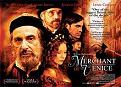
Westerners are not only known as history ignoramuses, but double dumbass history ignoramuses when it comes to the history of William Shakespeare and Shakespeare's plays. Since I'm the one-and-only Historyscoper (tm), let me quickly bring you up to speed before you dive into my Master Historyscope.
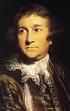
English #1 literary brain man "The Bard of Avon" William "Will" Shakespeare (1564-1616) is not only the greatest playwright who ever lived, but he has become part of the English cultural superiority arsenal, which has evidently worked since almost every educated person on Earth now speaks English whether they can understand him or not. The Library of Congress in Washington, D.C. contains 9,801 books written about him, coming in #2 after Jesus Christ (17,239), and way ahead of God (7,700) and Vladimir Lenin (4,492). The most-quoted English writer after the Bible, Shakespeare is the coiner of the words "hurry", "assassination", "bump", and "fancy-free", and the phrases "all that glitters is not gold", "all's well that ends well", "bated breath", "dead as a doornail", "fool's paradise", "good riddance", "heart of gold", "in a pickle", "laughing stock", "laugh it off", "love is blind", " naked truth", "neither rhyme nor reason", "one fell swoop", "pomp and circumstance", "pound of flesh", "star-crossed lovers", "too much of a good thing", "wear my heart upon my sleeve", "wild goose chase", "the world's my oyster" et al. Shakespeare is the most-quoted writer in the English language after the Bible, with 400+ feature-length film and TV versions of his plays released incl. 125+ versions of Romeo and Juliet, 50+ versions of Hamlet, and 20+ versions of Macbeth, many grossing big bucks. Let's scope Shakespeare and see how deep his rabbit hole goes.
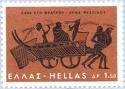
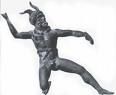
In 536 B.C.E. Greek tragedian Thespis invented Tragedy (Gr. "tragos" = goat, the sacred animal and symbol of wine god Dionysus AKA Bacchus) at the festival of the Greater Dionysia; it eventually developed the elements of Hamartia (fatal flaw, of which hubris is a favorite), Nemesis, and Catharsis - thespian jokes here?
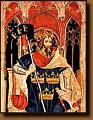
But that was ancient Greece, and we're talking about Merry Olde England, so first a little background. Since the time of Noah's Ark, England and all of Europe W of the Rhine River was run by 150 tribes of Celts, known for speaking the Gaelic language, and practicing the Druid religion, whose priests wore cool hooded robes a la Gandalf in "The Lord of the Rings". Too bad, they didn't have an alphabet, so their rich culture of poems and stories was pretty much lost, the most famous that survived being the story of King Arthur and the Roundtable, which became part of the cultural heritage of all English literati.
Starting with Julius Caesar, the Romans began a systematic conquest of the Celts, wiping them out in Europe and starting in on Britain, finally conquering it in 43 C.E. Any Celts who didn't die in battle or make a run for it and were captured or surrendered were forced to fight their brothers for the Romans while they knocked-up their wives, which we can take as the genesis of the modern English people.
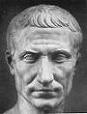
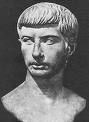
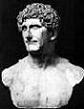
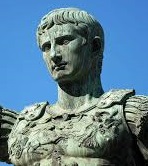
Speaking of Julius Caesar (-100 to -44), on Mar. 15, -44 (Ides of March) after falling under the spell of Egyptian glam babe pharaoh Cleopatra ("glory of the father") VII (-69 to -30), and being declared dictator for life by the people, making them jealous, he was assassinated by a group of senators led by Marcus Junius Brutus (-85 to -42), causing a civil war that led to the rise of Mark Antony (Marcus Antonius) (-83 to -30), who was doing good until he fell under the spell of Cleopatra, causing the Roman Senate to declare him a traitor and sic his arch-rival (Caesar's grandnephew) Octavian (Gaius Octavius) (-63 to 14) on him, who defeated them at the naval Battle of Actium in Greece on Sept. 2, -31, causing them to commit suicide in -30, after which Octavius went on to take over as Rome's first emperor Augustus ("revered or exalted one") in -27, ending the Roman Republic and setting the bar for all future dictators with his cool way of paying for tons of propaganda portraying him as the father of his people.
Back to the Celts. The Romans caused the Gaelic language to become bastardized into Old English (Anglo-Saxon). Then in the early 400s the Roman Empire began coming unglued under relentless assaults by the Germans, causing the Romans to completely pull out of Britain, allowing the remaining Celts hiding in the inaccessible places in Scotland and the west to come back and frolic, only to see the Germans start coming over the British Channel in their place. The three main German tribes were the Angles, Saxons, and Jutes. They were all pagan at first, but although the Roman Empire went kaput in 476 C.E., the pope and his hierarchy were still intact in Rome, and sent missionaries wherever the Roman roads could take them to proselytize, eventually Christianizing Britain.
The Germans took over Britain, but they couldn't finish the job the Romans started and exterminate the Celts, because just when things looked darkest, and they were about to wink out, a hero arose, a great king, who kicked the Saxons' butts around the year 500 in the epic Battle of Mons Badonicus (Badon Hill), making West England (Cornwall and Wales) safe for Celts for 50 years during the Golden Age of Camelot, a lot near the village of Queen's Camel in Somerset. That was King Arthur (-537), a real king. His chief druid Merlin was misnamed by Sir Thomas Malory (1405-71) in his Morte d'Arthur (pub. posth. in 1485), because at this late date he was so mixed up that he thought the Druidic Celtic king Arthur, whose name in Gaelic means rock, was a Christian king living in France, with a name based on Greek Arcturus, which means bear, and that the name Merlin came from Latin for hawk, when actually it was Mervyn (Myrddin the way they spell it in Welsh), meaning sea tower or lighthouse in Gaelic. The name of Arthur's babe Guinevere means soft and white in Gaelic, which makes sense every night, get it? Come here, baby, and let me put my rock in your soft and white, chuckle. Dirty but beautiful and poetic, like all Gaelic words. Gaelic is the most beautiful language in ancient Europe. There isn't an ugly word in it. And it would still would be, if it hadn't gotten corrupted and fragmented by other languages. The reason French is so beautiful is its absorption of Gaelic words, and even English has a large load. In Gaelic even bad babes sound good, like Morgana (Gael. "edge of the sea"), Arthur's evil Druid fairy half-sister. I'd like some Gwina in the evening and some Morgana in the morning, wouldn't you? Compare with guttural German, the ugliest language in Europe. It doesn't have a single beautiful word. The whole lingo sounds like dirty talk you would hear in the back of a sailor's whorehouse. Who'd want a Gretel, for instance, when they could have a Gwina or a Morgana, unless it was for a cheap quickie? How do they say I love you in German? "Ich liebe dich". Just imagine the tenderness of the scene, way back east of the Rhine: "Ich liebe dich, Hansel". "You want to lick my dick, Gretel?" "Jah, Hansel, ich liebe dich gut." "Well okay, but save some for later, will ya?" What a difference the Rhine River makes, eh? Funny, the French claim that St. Genevieve's name means white wave. Sounds like a coverup.
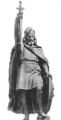
A big setback was the invasions of the pagan Norse (Vikings), particularly the Danes. In Nov. 866 after spending a year looting and gathering reinforcements in East Anglia to create the Great Heathen Army, Danish Vikings under Ivar Ragnarsson the Boneless (-873) sieged and captured Jorvik, later called York (the old Roman fort of Eburacum) in Mercia, settling in and terrorizing the Anglo-Saxons. In 899 Saxon king Alfred the Great (848-99) died after defeating the last Danish invasion, unifying all of Christian Britain as Saxon England. Of course the Norse left their mark on their language too.
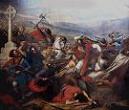
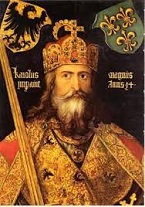
Meanwhile the systematic expansion of Christianity received the shock of its life with the rise of the long-awaited Antichrist Muhammad (570-632) of Arabia, whose new world domination cult Islam dispensed with sending missionaries in favor of sending fanatical armies that took over your country first and worried about converting you second. After quickly taking over the Holy Land, Egypt, and North Africa, in 711 they crossed the Strait of Gibraltar and took over Spain, then crossed the Pyreenes hoping to take over France followed by the rest of Europe. Luckily they were stopped in 732 by Frankish Merovingian king Charles Martel (the Hammer) (688-741), who saved Europe from Islamization. Too bad, his grandson king (768-714) Charlemage (Charles the Great) (742-814) got the wrong idea from the Muslims, and instituted the Sword and Cross program on the remaining pesky pagans in Europe, namely, take the cross or we'll give you the sword, spending 30 years crushing the Saxons and Frisians, only to make the mistake of trying it on the Norse, who simply took off in their longships and began terrorizing the coast of France, becoming so successful that they kept at it for the next 200+ years, taking Ireland, the NE part of England, and Denmark, and going east into Russia. Luckily, the missionary hype about Christ returning in the year 1000 to judge the world worked, and they started lining up to get baptized, turning their Thor's Hammers into crosses and joining the Christian side.
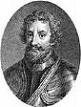
In Aug. 1040 in an attempt to end the threat to the succession from King Dub's descendants, Scottish king Duncan I (b. 1010) leads an army into Moray (N Scotland) against Macbeth (MacBeth) (Macbethad) (1005-57), mormaor (mormaer) (earl) of Ross and Moray, but it backfires when Macbeth defeats and kills him at Pitgaveny near Elgin, or alternatively, murders him at Macbeth's castle in Inverness on the mouth of the Ness River on Beauly Firth (120 mi. N of Perth), and becomes king in his place (until 1057); too bad, Donald's kiddie sons Malcolm and Donald Bane (Domnall Ban) are spirited away to refuge with the Norse-Gaelic rulers of the Hebrides, ending up in Northumbria with Earl Siward under protection of Edward the Confessor, which ends up backfiring as Malcolm gets infected with Anglo-Saxon culture and later brings it back to wild-and-wooly Gaelic Scotland with him?; Macbeth is regarded as a good ruler until Shakespeare smears him, and later historians overreact and paint him as a good ruler, but now it's anybody's guess? On July 27, 1054 after Edward Confessor again sanctions Earl Siward of Northumbria to invade Scotland in support of Malcolm Mac Donald (with a plan to install him as a client or puppet king), he defeats Macbeth (thane of Cawdor on the Moray Firth) in the bloody Battle of Birnam Wood Come to Dunsinane (Hill) at a hill fortress in C Scotland in the Sidlaw Hills in E Perthshire 7 mi. NE of Perth (Scone) on 1K-ft. Dunsinane Hill, overlooking the Carse of Gowrie and the Tay River Valley; Macbeth's Norman mercenary knights are wiped out; Earl Siward's eldest son is killed; too bad, Siward's V is so costly that he is forced to retire without accomplishing any objective other than putting Malcolm in control of the area S of the Firth River, causing him to have to begin a war of attrition against Macbeth, slowly pushing him N - the weird sisters were right or full of it? In Aug. 1057 after crossing the Mounth, Duncan I's son and avenger Malcolm Mac Duncan kills Macbeth (b. 1005) in Lumphanan, near Aberdeen (where the road into Moray runs N from Deeside); Macbeth's army wins, though, and he is succeeded by his stepson Lulach Mac Gillcomgain (the Fatuous) (the Simpleton) (-1058) as king of listen-to-the-music-of-the-traffic-in-the-city kingdom of Scotland.
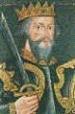
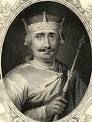
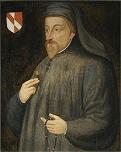
In 1066 the French-speaking Norse Viking transplant Normans led by William I the Conqueror (1028-87) invaded and captured Britain, imposing their haughty French culture on the Anglo-Saxons after crushing them like dogs, and crushing the expected revolts so cruelly that they wasted northern England so bad that it still hasn't recovered. William I's elder son William II Rufus (Red) (1056-1100) completed the crushing of the dogs, reducing even the nobility to little more than serfs. Speaking of not recovering, the Arden Family, named after the Arden Forest in Warwickshire was founded by Alwin (Aethelwine), sheriff of Warwickshire, nephew of Earl Leofric of Mercia, becoming one of only three Anglo-Saxon families to survive to modern times, counting William Shakespeare as a descendant via his mother Mary Arden. Too bad, no matter how hard the Normans tried to make them speak French, the downtrodden Anglo-Saxon dogs wouldn't give up their double bastard German-Celtic language, resulting in the triple bastard language of Middle English, without which there would have been no Shakespeare. After outwitting, outplaying, and outlasting the Normans, their big breakthrough was with Geoffrey Chaucer (1343-1400), who turned Middle English into a respectable literary language, becoming known as the Father of English Literature, after which Chancery Standard was adopted in London around 1470, allowing Early Modern English (Shakespeare's language) to take over, lasting until 1550, when Modern English took over after the Great Vowel Shift that began in 1350 ended, forever messing up English spelling.
The Normans had no intention of stopping with conquering the Anglo-Saxons. They wanted the entire British Isles, incl. the Welsh, Scots, and Irish. Luckily for them, in 1096-99 the First Crusade to take back Jerusalem from the Muslims diverted their energies. Only when the Seventh (Last) Crusade ended in 1270 did the English kings put their pesky Celtic neighbors back on the top of the list, although Ireland was already conquered in 1170 by Henry II.

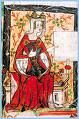

In 1100 William I's 4th son Henry I Beauclerc (good clerk, meaning he could read) (1068-1135) became Norman king #3 of England after his elder brother William II was conveniently killed in a hunting accident, pacifying the Anglo-Saxons by marrying a descendant of their royal house. After his death England descended into civil war because his daughter and heir Empress Matilda (Maude) (1102-67) was an er, woman, and her cousin (a grandson of William I) Stephen of Blois (1092-1154) had a large following.
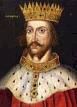
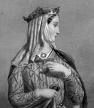
In 1154 England was finally united by Maude's son Henry II (1133-89), first of the House of Plantagenet (Fr. "sprig of broom"), who ruled the rich French county of Anjou, resulting in the Angevin Empire that stretched from the Pyrenees to Ireland and the border with Scotland. His wife was manly woman Eleanor of Aquitaine (1122-1204), see any Katherine Hepburn outtake.
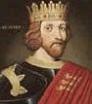
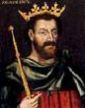
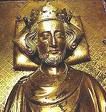
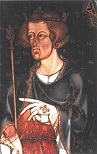
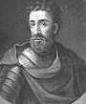
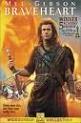
Henry II was succeeded by his illegitimate son Richard I Lionheart (1157-99), who spoke only French and spent most of his reign on Crusade, leaving his evil backstabbing brother (Henry II's youngest son, who didn't inherit any lands, making him bitter) John Lackland (1166-1216) in charge, who took over after Richard was killed in France in 1199, and was such a prick that he was revolted against by his barons and made to sign the Magna Carta (Charta) at Runnymeade near Windsor Castle on June 15, 1215, only to see him renege with papal support, causing them to launch the First Barons' War, which was supported by Louis VIII of France. Before they could win, John died of dysentery (really poisoned by the monks to get rid of the bum?), causing his 9-y.-o. son Henry III (1207-72) to succeed, with the barons acting as regents while they waited to see if he would accept the Magna Carta when he reached adulthood. He did, and went on to rule 56 years, turning into an old fart that was forced to call the first Parliament in 1264, while his eldest son Edward I Longshanks (1239-1307) become de facto king. Edward I spent his reign crushing the Welsh and Scots, calling himself "Hammer of the Scots", until he came up against Scottish hero Sir William Wallace (1272-1305), see the Mel Gibson flick even though it's full of moose hockey.
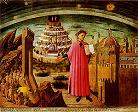
Meanwhile in the 1220s the Sonnet (Ital. "little song or sound") poetic form was invented by Italian poet Giacomo da Lentini (Giacumu da Lintini) (Jacopo il Notaro) at the court of freethinking Hohenstaufen Holy Roman Emperor (1220-50) Frederick II (1194-1250) in Sicily, after which in 1235 Giacomo da Lentini of Tuscany rediscovered the sonnet form and founded the Neo-Sicilian School (until 1294). Later in 1308-21 Italian poet Dante Alighieri (1265-1321) produced the #1 medieval poem The Divine Comedy, which set the bar high for the English, who were still considered backward rubes.
When Edward I died, his eldest son Edward II (1284-1327) became king of England. Too bad, his bi ways pissed-off the nobles, allowing his wife Isabella to depose him in Jan. 1327 in favor of his 14-y.-o. son Edward III (1312-77), whom she and her lover Roger Mortimer controlled until he got old enough and overthrew them in 1330. In 1337 he declared himself the rightful heir to the French throne, starting the Hundred Years' War between the House of Plantagenet (Anjou) and the House of Valois, which took until 1453 because the Great Plague threw it for a loop; the net result was that England was all-but kicked out of France except for Calais.
In 1347-50 the Black Death devastated Europe, killing a third or half of all the people and livestock, and giving it an existential moment, forever changing it because until then the Church had a stranglehold on peoples' minds with its claim of being the doorkeeper to Heaven with a pipeline to God, only to be found unable to stop the plague from even hitting its own prelates, albeit they make a good try of blaming it on the pesky Jews. After that the intelligentsia began to wonder what the world was like before the Church started time over with year one, and began to delve into the hitherto-forbidden works of the pagan ancient Greeks and Romans, launching the Renaissance, which caused a flowering of arts and sciences along with humanism, as people began living for today rather than counting on eternity, drum roll please. Of course the intelligentsia still had to put on that they were devout to avoid the horrors promised heretics. It was also the beginning of the labor movement as the lack of labor allowed them to organize for higher wages, receiving the expected reactionary oppression, which just made them more determined.
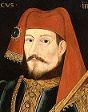
In 1377 10-y.-o. Plantagenet Richard II (1367-1400), son of Edward the Black Prince became king of England, until he was done in by Henry of Bolingbroke in Lincolnshire, who became Henry IV (1366-1413), the first king of the House of Lancaster.
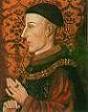
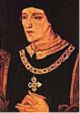
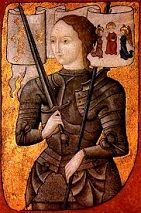
In 1413 Henry V (1386-1422) became the 2nd Lancaster king of England, going on to win a big V at the Battle of Agincourt on Oct. 25, 1415 (St. Crispin's Day), which caused Charles VI of France to sign the May 21, 1420 Treaty of Troyes recognizing him as the heir to the French throne, and give his daughter "Kiss Me Kate" Catherine of Valois (1401-37) to him. Too bad, Henry V suddenly died of dysentery in France, leaving infant son Henry VI (1421-71), whom the French wouldn't recognize, ramping up the Hundred Years' War, which the English were winning until "The Maid of Orleans" Joan of Arc (1412-1431) came out of the provinces with a Mission from God and turned things around, albeit at the expense of her own life. Henry VI's periods of insanity helped bring down the House of Lancaster and elevate the House of York, pass the patties please.

In 1439 German Man of the Millennium Bill Gatesenberg, er, Johannes Gutenberg (1398-1468) invented movable type printing, revolutioning the world. Unlike Bill Badenberg Gates, he wasn't greedy, and gave his invention to the world.
In May 1450 Jack Cade (b. 1420) led a peasant revolt to protest high taxes to pay for the Hundred Years' War, leading 5K to London, causing Henry VI to flee to Warwickshire while they looted, only to be defeated in a battle on London Bridge and scatter; Cade was killed on July 12, 1450. Shakespeare made him a character in "Henry VI, Pt. 2", with the soundbyte "The first thing we do, let's kill all the lawyers" (4.2.83-4).
In 1453 the Muslim Ottomans finally captured Constantinople, which had withstood all attacks for a thousand years, allowing them to begin moving up the Balkans towards Europe's back door, which absorbed their energies and allowed the west side of Europe to spring ahead.



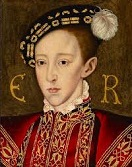
In 1455 the Wars of the Roses between the two rival branches of the House of Plantagenet, the bloody red rose of Lancaster and the white peppermint patty of York began. On Mar. 4, 1461 Yorkist Edward VI (1442-83) became king of England, surviving a Lancastrian challenge at the May 4, 1471 Battle of Tewkesbury, only to die a sudden death in the Tower of London (murdered?).
In 1476 William Caxton (1415-92) set up the first printing press in England at Westminster, and in 1485 printed the 21-vol. posth. work Le Morte d'Arthur (Le Morte Arthure) (The Book of King Arthur and His Noble Knights of the Round Table) by Sir Thomas Malory (1405-71), the first book in poetic prose, and the first novel in the English language, which Malory wrote while rotting in prison on trumped-up charges after calling for reform during the Wars of the Roses; it was based on an anon. early 13th cent. 4-part French work La Mort le Roi Artu (1237); Malory put bits of his own life in Arthur's tale; after Arthur is mortally wounded, Sir Bedivere throws Excalibur in the lake so that it will not see him dead, and "there came an arm and an hand [the Lady of the Lake] above the water and met it, and caught it, and so shook it thrice and brandished, and then vanished away the hand with the sword in the water"; Arthur then goes to the "Vale of Avilion (Avalon), to heal me of my grievous wound"; "Yet some men say in many parts of England that King Arthur is not dead, but taken by the will of our Lord Jesu into another place; and men say that he shall come again, and he shall win the holy cross"; "Here lies Arthur, once and future king" becomes the dream of all English kings, who want to claim that they're him, whether or not they are of Celtic heritage?; the Winchester Manuscript was unearthed in 1934.
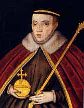
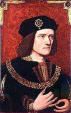
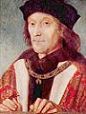
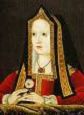

In 1483 hunchback cripple Yorkist Richard III (1452-85) became king of England after murdering 12-y.-o. 2-mo. king Edward V (1470-83), causing a civil war that kicked his butt at the Aug. 22, 1485 Battle of Bosworth Field, causing Lancastrian Henry VII (1457-1509) to become king, who ended the War of the Roses by marrying Elizabeth of York (1466-1503), thus uniting the houses under the new Tu-Tone name of Tudor.
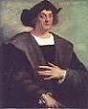
On Oct. 12, 1492 with Spanish financing, Italian mystery man (probably a secret Jew) Christopher Columbus (1451-1506) discovered the New World of America, wowing Europe and providing more ammunition for the intelligentsia that suspected not only the Church but the Bible itself of being a fake, since there was no mention or even hint of it in its pages. Of course the Church stepped up the repression, creating a relentless war between Science and Religion that ultimately backfired by the 19th cent. The Portuguese soon entered the Space Race and claimed South America, and both of these Catholic countries soon became rich, which ended up ruining them and spilled over to the Church, corrupting the already-corrupt papacy worse than ever. Meanwhile the English were content with pirating the big fat elephantine Spanish treasure galleons on their way to the mother country, keeping them from being interested in the hard work of settlement and conquest in North America for a century.
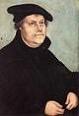
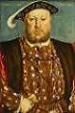
On Oct. 31, 1519 (Halloween) Roman Catholic monk Martin Luther (1483-1546) finally got tired of the astronomical corruption of the Church and broke with it, nailing his 95 Theses to the church door at Wittenberg, and launching the Protestant Reformation. At first English Tudor king #2 (1509-47) Henry VIII (1491-1547) was against the Reformation, until his wife Catherine of Aragon was found unable to produce a male heir, causing him to try anything to get a legal annulment of his marriage, and when that failed, he flopped and went Protestant bigtime, breaking with the Church completely and setting up his own national church. After he died, England went into a civil war over religion that was ended by the accession of his daughter Elizabeth I.
In 1534 John Farlyon became the first Master (Yeoman) of the Revels in England, followed in 1544 by Sir Thomas Cawarden (1559) (first independent office), in 1560-72 by Sir Thomas Benger (1520-77), in 1573-79 by Sir Thomas Blagrave (-1590), and in 1579-1610 by Sir Edmund Tylney (Tilney) (1536-1610), who got into gen. censorship and licensing of theaters, which in 1624 was put directly into the hands of the Lord Chamberlain, followed in 1737 by the Licensing Act of 1737, which gave the power to the Examiner of the Stage, who works for the Lord Chamberlain; the function was not abolished until 1968 by the Theaters Act; Shakespeare's Hamlet, Act 2, Scene 2 refers to Benger's child actors from The Children of St. Paul's with the line: "An aery of children, little eyeases that cry out on the top of question and are most tyranically clapped for it: these are now the fashion;/ and so berattle the common stages that many wearing rapiers are afraid to goose quills and dare scarce come hither."
In 1542 Edward Halle (Hall) (1497-1547) pub. The Union of the Two Noble and Illustre Famelies of Lancastre and York (Hall's Chronicle), covering English history from Henry IV (1367-1413) to Henry VII (1399-1547); 2nd ed. by Richard Grafton in 1548; it became a main source used by Shakespeare for his historical plays.
In 1557-60 William Whittingham (1524-79), Myles (Miles) Coverdale (1488-1569) et al. pub. The Geneva Bible in London, an inexpensive portable English Bible with extensive Calvinist-slanted "annotations upon all the hard places" (marginal glosses), furnished with instructional aids, becoming the first study Bible, and the first using verse numbering by Robert Estienne (Stephanus) of Paris; dedicated to Queen Elizabeth I, it is often used and/or quoted by John Knox, John Bunyan, John Donne, Oliver Cromwell, and Shakespeare, and later preferred by Puritans over the King James Bible, dissing the divine right of kings and always translating the word king as tyrant, causing Charles I to ban it in 1644, leading to Puritan takeover of the govt. and his beheading, even though they later realize the superiority of the 1611 KJV.
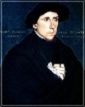
In 1557 Richard Tottel (-1594) pub. Songs and Sonnets written by the Ryght Honorable Lorde Henry Howard late Earle of Surrey, and Other (Tottel's Miscellany), the first anthology of English poetry, and the first pub. of the poetry of Sir Thomas Wyatt (1503-42) and Henry Howard, Earl of Surrey (1517-47), introducing the English 14-line sonnet (based on Italian models); Wyatt uses the Italian or Petrarchan sonnet form (abba, abba, cdc, dee), while Howard invents the English or Shakespearean form of three quatrains (abab, cdcd, efef) and a couplet (gg); later Sir Edmund Spencer invents his own form (abab, bcbc, cdcd, ee).
In 1566-7 London-born Willliam Painter (Paynter) (1540-95) pub. The Palace of Pleasure Beautified (2 vols.) (combined ed. 1575), a translation of a collection of 94 Italian novellas, allegedly used by Shakespeare as a source of several plots.
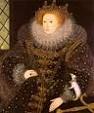
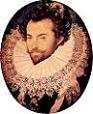
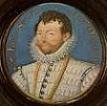
On Nov. 17, 1558 Henry VIII's daughter (by Anne Boleyn) Elizabeth I (1533-1603) became queen of newly-Protestantized England, starting out with the entire Roman Catholic Church out to kill the "bastard heretic", until she won the epic Battle of the Spanish Armada on Aug. 8, 1588, launching the exhilarating golden Elizabethan Age (Era), marked by national cultural renaissance and international expansion via the seas. Indeed, England got its first ideas about taking over the world, making it necessary to invent a Shakespeare even if there hadn't been one. The Virgin Queen created a national religious cult with herself as the Virgin Mary, just like her daddy Henry VIII broke off from the Church and made himself the English pope, it was great, see the movies, what cocks they were to dress like that with giant ruffles around their necks. Major figures of the Elizabeth Age incl. Sir Walter Raleigh (1552-1618), and Sir Francis Drake (1540-96).
In 1563 William Shakespeare's father John Shakespeare is appointed chamberlain for the Stratford Corp. (until 1564), authorizing a 2 shilling payment for "defasying ymages in ye chapel", as required by an English Reformation law passed by Edward VI in 1547.
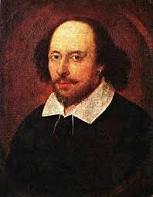
On Apr. 23, 1564 (May 3 Gregorian) (Sun.) (St. George's Day) English Elizabethan/Jacobean #1 poet-playwright ("the Bard of Avon") William "Will" Shakespeare (1564-1616) (anagram for "We all make his praise", "I am a weakish speller") [Taurus] was born in a tall jar, er, a half-timber Tudor house in Stratford-upon-Avon (Stratford-on-Avon) 100 mi. N of London in Warwickshire (second w not pronounced); he was baptized on Apr. 26, and we're just guessing that he was born on Apr. 23. He was the eldest of six children (3rd eldest of eight, of whom the first two died before him) incl. Joan (1558), Margaret (1562-3), Gilbert (1566-1612), Joan II (1569-1646), Anne (1571-79), Richard (1574-1613), and Edmund (1580-1607); father John Shakespeare (1531-1601) from Snitterfield was a glove maker and leather merchant, and worked for the town council tasting locally-produced beer, and acted as bailiff (sheriff); mother Mary Arden (1537-1608) (married in 1557) was from a wealthy local family; in summer 1564 the plague killed 200+ of his neighbors; Will attended King Edward VI Grammar School, whose teachers came from Oxford U. Will's father was plagued with accusations of illegal moneylending and wool dealing by professional informers starting in 1569, and was in financial and legal trouble until 1583, shaping Will's attitude to power and morality as seen in "King Lear" and "Macbeth"?
In 1567 the Red Lion Theatre in Whitechapel (modern-day Tower Hamlets) outside London was built, becoming the first permanent theater in England built since Roman times; too bad, it folded after presenting The Story of Samson because it was built on open farmland that's too hard to get to in the winter.
On Dec. 19, 1571 glammed glowing William Shakespeare, er, Edward de Vere, 17th Earl of Oxford (1550-1604), known for his slender figure and hazel eyes, good classical education, and skill in dancing, horsemanship, and playing the virginals married Anne Cecil (1556-89), daughter of Lord Burghley at Westminster Abbey, and Queen Elizabeth I attends, giving him the nickname of "her Boar"; expected to be a court favorite, with the queen "delighting more in his personage and his dancing and valiantness than any other", he ended up going for overseas adventure.
In 1572 the mayor of London banned plays and playhouses to protect against the plague, and in 1575 he banned players too, causing playhouse owners to begin building outside London's city limits.
In Dec. 1576 after James Burbage (Burbadge) (1530-97) (father of Richard Burbage) got pissed-off at the city of London for passing regulations on Inn-yards in 1574 and signed a 21-year lease of land in Finsbury Fields, Shoreditch (modern-day Hackney) outside the City of London Wall in an area known for houses of sin, with permission to build a playhouse, he opened The Theatre, becoming London's 2nd permanent theater after the Red Lion (1567), and the first successful permanent dedicated theatre built in England since Roman times, becoming home to the Lord Chamberlain's Men and actor-playwright William Shakespeare.
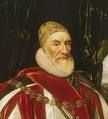
In Dec. 1576 the Admiral's (Lord Howard's) (Earl of Nottingham's) Men (Company), backed by powerful patron Lord High Adm. Charles Howard, 1st Earl of Nottingham (1536-1624) (cmdr. of the English fleet against the 1588 Spanish Armada) began performing at the Theatre, the first purpose-built public theater in London, becoming the #2 acting troupe after Shakespeare's Lord Chamberlain's Men.
In 1576 Francois de Belleforest pub. Histoires Tragiques, which incl. the story of Danish prince Amlet, who avenges his father's murder on his uncle after he marries his mother Geruthe, becoming a source for William Shakespeare'e "Hamlet"?
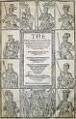
In 1577-87 English writer Raphael Holinshed (1529-80) et al. pub. Chronicles of England, Scotland, and Ireland (2 vols.), histories of England, Scotland, and Ireland by various writers; it incl. Description of Elizabethan England by William Harrison (1534-93); Holinshed wrote the history of England; it started out as a universal history by his boss, Dutch-born printer Reginald (Reyner) Wolfe (-1573), and this is an abridged vers.; it is used by Elizabethan dramatists incl. Shakespeare.
In 1579 Sir Thomas North (1535-1604) pub. an English trans. of Plutarch's Lives of the Noble Grecians and Romans, which becomes a major source for Shakespeare's plays.
On Nov. 28, 1582 Shakespeare married 8-year-older farmer's daughter Anne Hathaway (1556-1623) from nearby Shottery on the edge of the Forest of Arden (Lat. "burning for enthusiasm") ("William Shaxpere and Anne Whateley of Temple Grafton", according to the Nov. 27 episcopal register at Worcester). Their children were Susannah Hall (nee Shakespeare) (May 1583-July 1649), and twins Hamnet Shakespeare (Jan. 1585-Aug. 1596) and Judith Quiney (nee Shakespeare) (Jan. 1585-1662).
On Dec. 20, 1583 Edward Arden (b. 1542), son of William Arden, 2nd cousin of Shakespeare's mother Mary Arden was executed in the Tower of London for plotting against Elizabeth I and being a secret Roman Catholic.
In 1583 the Queen's Co. of Players was formed in London by Sir Edmund Tilney (Tylney) (1536-1610) after the Puritan-run Corp. of London closed the theaters on the Surrey shore under the claim that they spread the plague each summer.
Speaking of Sir Walter Raleigh, on Apr. 27, 1584 after English cleric Richard Hakluyt (1552-1616) began writing books inciting the English to begin colonizing North America, Raleigh sent an expedition, which landed in Roanoke Island, Virginia on July 4; too bad, by 1590 the settlers went injun, leaving the word "Croatoan" carved into a post at their fort.
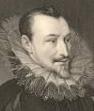
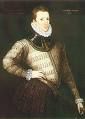
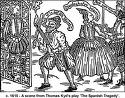
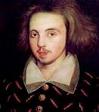
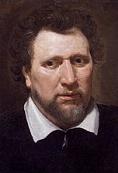
Before we get to Shakespeare, we might as well mention his rivals, other Elizabethan Poets and Playwrights, including Edmund Spenser (1552-99), author of The Faerie Queene (1590-6), Sir Philip Sidney (1554-86), author of Astrophel and Stella, Robert Greene (1558-92), who left the posth. Greene's Groats Worth of Witte (1592), taking a swipe at new kid on the block Shakespeare, Thomas Kyd (1558-94), author of The Spanish Tragedy (1582-92), the first English revenge play, and the most popular Elizabethan play, containing a play within a play, copied by Shakespeare in "Hamlet", George Chapman (1559-1634), the Rival Poet of Shakespeare's Sonnets, known for his translation of Homer, Christopher "Kit" Marowe (1564-93), author of Tamburlaine the Great (1587) Doctor Faustus, and The Jew of Malta (1592), Thomas Nashe (1567-1601), author of Summers Last Will and Testament (1592), with the famous lyric: "Adieu, farewell earths blisse,/ This world uncertain is/ Fond are life lustful joyes,/ Death proves them all but toyes,/ None from his darts can flye;/ I am sick, I must dye:/ Lord, have mercy on us", Sir William Alexander, 1st Earl of Stirling (1567-1640), Ben Jonson (1572-1637), author of Volpone (1605-6), The Alchemist (1610), and Bartholomew Fayre (1614), and John Webster (1580-1635), author of The White Devil (1612) and The Duchess of Malfi (1612-13), excuse me while I yawn.
In 1585 Shakespeare left the provinces for London, the lights, the crowds, the excitement, joining a band of actors and promising to send money back to his family (an unhappy marriage, or too dangerous for them to come along?) In 1587 he signed up with one of the two chief playing companies, that of James Burbage, beginning his Johannes Factotum (Jack of All Trades) Age (1587-92).
Note: The Chronology of Shakespeare's Plays is disputed, but we will mostly stick to the one in Wikipedia since it's as good as any, and the price is right.
In 1589-91 Shakespeare wrote the comedy The Two Gentlemen of Verona, his first play, which showed that he wasn't ready to handle scenes with more than four characters. It has the smallest cast of any Shakespeare play, and was the first in which the heroine (Julia) dresses as a boy. It borrows from Jorge de Montemayor's 1559 romance "Diana Enamorada", and John Lyly's 1589 play "Midas". It was not performed until 1762. It's the first of three plays (The Taming of the Shrew, Romeo and Juliet) set in Verona on the Adige River in N Italy, known for its humid subtropical climate. Summary: Valentine, his clownish servant Speed and babe Silvia (daughter of the duke of Milan); friend Proteus, whose servant is Launce (whose dog is Crab), and who jilts his babe Julia (whose maid is Lucetta) for Sylvia, and gets Valentine banished so he can close in; meanwhile foolish Thurio has been chosen for Sylvia by her daddy, and closes in on her, while pissed-off Julia dresses in drag and becomes Proteus' page Sebastian to win him back, after which Proteus tries in vain to woo Silvia, and finally tries to rape her, but she is saved by Valentine, who then turns around and gives her to him for friendship's sake, causing Julia to faint, give her identity away, and cause Proteus to suddenly fall in love with her, allowing Valentine to marry Silvia. "To be in love, where scorn is bought with groans" (Valentine) (1.1.30); "I have no other, but a woman's reason;/ I think him so because I think him so" (1.2.23-4) (Lucetta); "They do not love that do not show their love. (Julia)/ O! they love least that let men know their love (Lucetta)" (1.2.31); "Though ne'er so black, say they have angels' faces./ That man that hath a tongue, I say, is no man,/ If with his tongue he cannot win a woman" (3.1.103-4) (Valentine); "Nay then, the wanton lies; my face is black" (Thurio)/ "But pearls are fair, and the old saying is,/ Black men are pearls in beauteous ladies' eyes" (Proteus)/ 'Tis true, such pearls as put out ladies' eyes;/ For I had rather wink than look on them" (5.2.10-14) (Julia).
In the 1590s Elizabethan courtier George North (ambassador to Sweden) writes the unpub. ms. A Brief Discourse of Rebellion and Rebels, which in 2018 is discovered to be a source of 11 of William Shakespeare's plays (incl. "King Lear", "Macbeth", "Richard III", and "Henry V") by Dennis McCarthy and June Schlueter.
In 1590-1 Shakespeare wrote the history Henry VI, Pt. 2 ("The First part of the Contention betwixt the two famous Houses of Yorke and Lancaster, with the death of the good Duke Humphrey: And the banishment and death of the Duke of Suffolke, and the Tragicall end of the proud Cardinal of Winchester, with the notable Rebellion of Jack Cade: and the Duke of Yorke's first claim unto the Crowne"). Summary: Henry VI and his son Prince Edward of Wales (Edward VI), Duke Humphrey of Gloucester, Cardinal Beaufort, bishop of Winchester (great-uncle of Henry VI); Duke Richard Plantagenet of York and his son Duke Richard of Gloucester (Richard III); Edmund Beaufort, 2nd duke of Somerset; William de la Pole, 1st duke of Suffolk; Humphrey Stafford, 1st duke of Buckingham, Thomas Clifford, 8th baron de Clifford and his son John, Richard Neville, 5th earl of Salisbury; Richard Neville, 16th earl of Warwick, Thomas de Scales, 7th baron Scales; James Fiennes, 1st baron Saye and Sele. "Open your ears; for which of you will stop/ The vent of hearing when loud Rumor speaks?" (Intro., lines 1-2); "To weep is to make less the depth of grief" (2.1.85); "The game's afoot" (3.1.32); "Smooth runs the water where the brook is deep" (3.1.53); "Small things make base men proud" (4.1.106); "The first thing we do, let's kill all the lawyers" (Dick the Butcher) (4.2.83-4); "Presume not that I am the thing I was" (5.5.57). In 1590-1 he also wrote the history Henry VI, Pt. 3 (best of the three?). Summary: Henry VI, Queen Margaret of Anjou and son Prince Edward of Wales (Edward VI), Louis XI of France, Edmund Beaufort, 4th Duke of Somerset, Henry Holland, 3rd Duke of Exeter, John de Vere, 13th Earl of Oxford, Henry Percy, 3rd Earl of Northumberland, Ralph Neville, 2nd Earl of Westmorland, John Clifford, 9th Baron de Clifford, Duke Richard Plantagenet of York and his son Duke Richard of York (Richard III), Earl Edmund of Rutland, Duke George of Clarence, John Mowbray, 3rd Duke of Norfolk, John Neville, 1st Marquess of Montagu, Richard Neville, 16th Earl of Warwick, William Herbert, 1st Earl of Pembroke, William Hastings, 1st Baron Hastings. "O tiger's heart wrapped in a woman's hide!" (1.4.137); "The battle fares like to the morning's war,/ When dying clouds contend with growing light,/ What time the shepherd, blowing of his nails,/ Can neither call it perfect day nor night." (2.5.1-4); "Peace! Impudent and shameless Warwick, peace;/ Proud setter up and puller down of kings!" (3.3.156); "I'll drown more sailors than the mermaid shall;/ I'll slay more gazers than the basilisk;/ I'll play the orator as well as Nestor,/ Deceive more slily than Ulysses could,/ And, like a Sinon, take another Troy./ I can add colours to the chameleon,/ Change shapes with Proteus for advantages,/ And set the murderous Michiavel to school./ Can I do this, and cannot get a crown?/ Tut, were it farther off, I'll pluck it down." (3.3.187-94); "Hasty marriage seldom proveth well" (4.1.18); "A little fire is quickly trodden out/ Which, being suffered, rivers cannot quench" (Duke of Clarence) (4.8.7); "Why, what is pomp, rule, reign, but earth and dust?/ And, live how we can, yet die we must" (5.2.23-28); "Suspicion always haunts the guilty mind;/ The thief doth fear each bush an officer" (5.6.11-12); "Down, down to hell; and say I sent thee thither" (Gloucester) (5.6.69).
In 1590-2 Shakespeare wrote the comedy The Taming of the Shrew, which was first performed on June 13, 1594 at Newington Butts Theatre, becoming his first performed play; set in Verona. Summary: Baptista of Padua has two daughters, the shrew Katherina and the beautiful money daughter Bianca, and holds off marrying Bianca until somebody takes Katherina off his hands; enter Petruchio, who tames her, allowing Lucentio to pay a fortune for the other. "I'll not budge an inch" (1.14); "Such duty as the subject owes the prince/ Even such a woman oweth to her husband" (Katherina) (5.2.156-7).
In 1591 Shakespeare wrote the history Henry VI, Pt. 1; his weakest play?
In 1591-2 Shakespeare wrote his first tragedy, the gory Titus Andronicus; Titus has 687 lines, 14th most. Summary: Roman Gen. Titus Andronicus vs. Gothic Queen Tamora; Titus' sons Lucius, Quintus, Martius, and Mutius; Tamora's sons Demetrius, Chiron, and Alarbus; Tamora's lover Aaron the Moor.
In 1592 William Shakespeare began his Lyrical Age (ends 1596); in 1592 he is mentioned as an actor for the first time by Robert Greene (1558-92) in his posth. autobio. Greene's Groates-Worth of Wit Bought with a Million of Repentence, ed. by dramatist Henry Chettle (1560-1607), which contains an alleged swipe on new kid on the block William Shakespeare, alluding to the line "O tiger's heart wrapped in a woman's hide" in "Henry VI, Part 3", with the soundbyte: "...for there is an upstart Crow, beautified with our feathers, that with his Tygers hart wrapt in a Players hyde, supposes he is as well able to bombast out a blanke verse as the best of you: and being an absolute Johannes fac totum, is in his owne conceit the onely Shake-scene in a countrey".
In 1592 Shakespeare wrote the history Richard III; Richard III has 1,124 lines, 3rd most. Summary: Edward IV of England (who usurped the throne from Henry VI), his brother George, Duke of Clarence, his other brother Richard, Duke of Gloucester (Richard III), his wife Elizabeth, Richard's ally the Duke of Buckingham, Lady Anne (widow of Edward, prince of Wales) (later Richard's wife), Henry VI's widow Margaret, the Earl of Richmond (Henry VII). "Now is the winter of our discontent/ Made glorious summer by this sun of York" (1.1.1); "No beast so fierce but knows some touch of pity" (1.2.71); "Talkers are no good doers" (1.3.351); "Things sweet to taste prove in digestion sour" (1.3); "For God's sake, let us sit upon the ground/ And tell sad stories of the death of kings"; (3.2); "Not all the water in the rough rude sea/ Can wash the balm from an anointed King" (3.2); "Discharge my followers; let them hence away,/ From Richard's night to Bolingbrooke's fair day" (3.2); "A horse! a horse! my kingdom for a horse!" (5.4.7); "Keep time! How sour sweet music is when time is broke and no proportion kept!/ So it is in the music of men's lives./ I wasted time, and now doth time waste me;/ For now hath time made me his numb'ring clock;/ My thoughts are minutes, and with sighs they jar/ Their watches on unto mine eyes, the outward watch,/ Whereto my finger, like a dial's point,/ Is pointing still, in cleansing them from tears”; (5.5.42-54); "No matter where; of comfort no man speak:/ Let's talk of graves, of worms, and epitaphs;/ Make dust our paper and with rainy eyes/ Write sorrow on the bosom of the earth"; "For sorrow ends not, when it seemeth done"; "No deeper wrinkles yet?/ Hath sorrow struck/ So many blows upon this face of mine/ And made no deeper wounds?'; "I hate the murderer, love him murdered"; "More are men's ends mark'd than their lives before:/ The setting sun, and music at the close,/ As the last taste of sweets, is sweetest last,/ Writ in remembrance more than things long past"; "Mine honor is my life; both grow in one./ Take honor from me, and my life is done"; "O that I were a mockery king of snow/ Standing before the sun of Bolingbroke/ To melt myself away in water drops!'; "Woe, destruction, ruin, and decay; the worst is death and death will have his day"; "This royal throne of kings, this sceptered isle/ This earth of majesty, this seat of Mars./ This other Eden, demi-paradise./ This fortress built by Nature for herself/ Against infection in the hand of war,/ This happy breed of men, this little world,/ This precious stone in the silver sea,/ Which serves it in the office of a wall/ Or as a moat defensive to a house,/ Against the envy of less happier lands, - / This blessed plot, this earth, this realm, this England."
In 1592-3 Thomas Kyd (1558-94) and Shakespeare wrote the history Edward III, which is filled with gibes against Scotland and its people; it was printed anonymously in 1596, and not incl. in the First Folio, which was pub. during the reign of Scottish king James I. Coincidence or not, on May 11, 1593 the English privy council ordered the arrest of all authors of "divers lewd and mutinous libels" that had been posted around London, and on May 12 Kyd was arrested at the Chislehurst home of Thomas Walsingham of Scadbury (1561-1630) (where he lived with Christopher Marlowe, who had been given the home to ride out the plague), and an Arian tract was found that "denies the eternal deity of Jesus Christ our Lord and Saviour", causing him to be tortured and rat out rommate Marlowe, who is arrested on May 20 to obtain his release; on May 30 after appearing before the privy council and awaiting their decision, Canterbury, Kent-born gay pedophile ("They that love not tobacco and boys are fools") and blasphemy-loving ("Christ was a bastard and his mother unchaste", "The woman of Samaria and her sister were whores and Christ porked them", "St. John the Evangelist was Christ's gay bud and that's why he always leaned in his bosom, he used him as the sinners of Sodom") poet-playwright Christopher "Kit" Marlowe (1564-93) was killed (stabbed above the right eye) in a Deptford house brawl (after arguing over the bill) by Ingram Frizer (-1627) (a member of Walsingham's secret service, along with Marlowe?) with a dagger that he snatched from Marlowe's hand (after Marlowe snatched it from him and attacked him first?), dying theatrically with a blood-curdling scream, cursing and blaspheming; Frizer got a royal pardon for self-defense on June 28; Kyd was ruined and soon died bankrupt; was Marlowe meeting with agents of Sir Robert Cecil about a secret mission to Scotland concerning James VI?; was the corpse of a murdered sailor substituted for Marlowe's for the inquiry, and Marlowe faked his death, going on to be the real Shakespeare?; the murder took place 4 mi. from the site of John Penry's execution. Marlowe's work established blank verse in English theater, although his bombastic, blood-and-thunder plots, filled with improbabilites and impossibilities and wildly ranting dialogue are no match for Shakespeare?
In 1593 Shakespeare began writing the 154 "sugred" Sonnets (pub. in 1609 without his permission) about the Dark Lady, "black as hell as dark as night"; "Then I will swear Beauty herself is black/ And all they foul that thy complexion lack" (#132); "Shall I compare thee to a summer's day?" (#18); earliest was written in 1589?
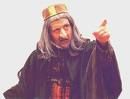
Basically I find your screensaver offensive? On Jan. 1, 1594 Elizabeth's chief physician Roderigo (Ruy) (Roger) Lopez (Lopes) (b. 1517) (a Portuguese Jew who fled to England in 1559 to escape the Inquisition and converted to Christianity under the name Christian but can't fix his hook nose?) (inspiration for Shylock in Shakespeare's "The Merchant of Venice"?) is arrested for treason, railroaded to conviction by Essex and executed (hanged, drawn and quartered) on June 7 at Tyburn along with alleged accomplices Esteban Ferreira et al. after being accused of a plot to poison Portuguese pretender Don Antonio (living in London) and/or the queen; he protests his innocence to the end, with the soundbyte that "He loved the queen as he loved Jesus Christ", giving the crowd a big laugh because to them he's forever a Jew; he was probably innocent, and Essex just wanted to score one on a Christ-killer to please da queen, although it backfires when she keeps a ring that Philip II had given Lopez in 1587 which he had offered her but she had refused, wearing it until she dies?

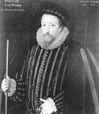
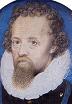
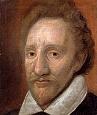
In May 1594 the theaters in London were reopened; the Lord Chamberlain's Men was chartered by Lord Chamberlain (1585-96) Henry Carey (1687-1743), 1st Baron Hunsdon (1526-96), son of Anne Boleyn's sister Mary and first cousin to Elizabeth I; when he died his son George Carey, 2nd Baron Hunsdon (1547-1603) took over; Shakespeare worked for the company for most of his career; besides Shakeaspeare, the company's main actor was Richard Burbage (1568-1619), son of impresario James Burbage, who played the title role in Shakespeare's "Hamlet", "Othello", "Richard III", and "King Lear", having no problemo with the unprecedented number of lines he had to memorize. Too bad, he had to play second fiddle to tall London thespian Edward Alleyn (1566-1626), who specialized in Marlowe's and Kyd's plays, and never acted in one of Shakespeare's, founding the rival Admiral's Men at the Rose on the S shore.
In 1594 Shakespeare wrote the comedy (his shortest play) The Comedy of Errors (The Night of Errors) (1770 lines total), about two sets of twins, Antipholus of Syracuse and his servant Dromio, and Antipholus of Ephesus and his servant Dromio; Adriana, Luciana, Egeon and Emilia, Angelo; only play to mention America; "err" refers to syphilis. In 1594-5 he wrote the comedy Love's Labour's Lost, first pub. in 1597. Inspired by Sir Francis Bacon's travels in 1576-9 with Sir Amyas Paulet, English ambassador in France, incl. Navarre. Summary: the king of Navarre and his lords Berowne, Longaville and Dumain, Holofernes the schoolmaster (really Italian-born English court brain man John Florio (1553-1625)?), the princess of France and her attendants Rosaline, Maria, and Katherine, and her advisor Boyet, Don Armado from Spain, country girl Jacquenetta and her beau Costard the clown, who plays "fast and loose" (1.2.153) by breaking the king's commandment to keep all women at least 1 mi. from his court for 3 years; Act 1 Scene 5 contains Shakespeare's longest word (27 letters) (uttered by Costard), "honorificabilitudinitatibus" (the state of being able to achieve honors); an anagram for "hi ludi, F. Baconis nati, tuiti orbi" (these plays, F. Bacon's offspring, are preserved for the world" and/or "I, B. Ionsonii, uurit a lift'd batch" (I, Ben Johnson, writ a lift'd batch) - let me floccinaucinihilipilificate about that a minute? In 1594-6 he wrote the history play King John, which was not pub. until the First Folio in 1623. Summary: King John of England, his mom Eleanor, his nephew Arthur, King Philip of France, justiciar Hubert de Burgh, Philip Faulconbridge the Bastard (Sir Richard Plantagenet, son of Richard Lionheart), Cardinal Pandulph; "To gild refined gold, to paint the lily.../ Is wasteful and ridiculous excess" (4.2.11-16); "This England never did, nor ever shall,/ Lie at the proud foot of a conqueror" (5.7.112-3).
In 1595 Shakespeare might have written the comedy Love's Labour's Won, which was mentioned by Christopher Hunt in Aug. 1603 but never found.
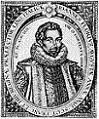
Also in 1595 Shakespeare wrote the history Richard II (Richard II has 753 lines, 11th most). Summary: Richard II of England and his cousin Henry Bolingbroke (Henry IV), Henry's daddy John of Gaunt, Duke Edmund of York (John's brother), Thomas Mowbray, Duke of Norfolk. "The purest treasure mortal times afford/ Is spotless reputation" (1.1.177); "How long a time lies in one little word!" (1.3.213); "This royal throne of kings, this scepter'd isle/... This happy breed of men, this little world,/... This blessed plot, this earth, this realm, this England,/ This nurse, this teeming womb of royal kings,/ Fear'd by their breed and famous by their birth" (2.1.40); "The ripest fruit first falls" (2.1.154); "You pluck a thousand dangers on your head/ You lose a thousand well-disposed hearts" (Edmund) (2.1.205-6); "Not all the water in the rough rude sea/ Can wash the balm from an anointed king" (3.2.54); "The worst is death, and death will have his day" (3.2.103); "And nothing can we call our own but death,/ And that small model of the barren earth/ Which serves as paste and cover to our bones./ For God's sake, let us sit upon the ground/ And tell sad stories of the death of kings.../ All murdered; for within the hollow crown/ That rounds the mortal temples of a king/ Keeps Death his court... and with a little pin/ Bores through his castle wall, and farewell king!" (3.2.152-170). "He is come to open/ the purple testament of bleeding war" (3.3.93); "And my large kingdom for a little grave,/ A little little grave, an obscure grave" (3.3.153).
Also in 1595 Shakespeare wrote the tragedy Romeo and Juliet, an update on the Pyramus and Thisbe story set in Verona, based on the 1562 Arthur Brooke (Broke) poem The Tragicall Historye of Romeus and Juliet; "It is a play of itself the worst that I ever heard in my life" (Samuel Pepys, 1662); first romantic play to feature an onstage kiss between a man and woman. Summary: Romeo Montague and his friend Mercutio, Juliet Capulet and her nurse and cousin Tybalt, Friar Laurence, Count Paris (whom Juliet jilts for Romeo); Romeo means "pilgrim to Rome" in Italian, Juliet means "youthful". "Two households, both alike in dignity"; "A pair of star-crossed lovers take their life" (Prologue, line 6); "O Romeo, Romeo! wherefore art thou Romeo?/ Deny thy father, and refuse thy name;/ Or, if thou wilt not, be but sworn my love,/ And I'll no longer be a Capulet" (2.2.33); "What's in a name? that which we call a rose/ By any other name would smell as sweet" (2.2.43); "Call me but love, and I'll be new baptized" (2.2.50); "For stony limits cannot hold love out" (2.2.67); "At lovers' perjuries/ They say, Jove laughs" (2.2.92); "In truth, fair Montague, I am too fond" (2.2.98); "O! swear not by the Moon, the inconstant Moon,/ That monthly changes in her circled orb,/ Lest that thy love prove likewise variable" (2.2.109-11); "Good night, good night! parting is such sweet sorrow,/ That I shall say good night till it be morrow" (Juliet) (2.2.184); "Wisely and slow; they stumble that run fast" (2.3.94); "O flesh, flesh, how art thou fishified!" (2.4.41); "A plague o' both your houses!/ They have made worms' meat of me" (3.1.112); "Adversity's sweet milk, philosophy" (3.3.54); "Hang up philosophy!/ Unless philosophy can make a Juliet" (3.3.54); "My only love sprung from my only hate" (Juliet).
In 1595-6 Shakespeare wrote the comedy A Midsummer Night's Dream, composed for a noble marriage in the winter as a visualization of an ideal summer, and one of the few plots he didn't borrow from others. Ben Jonson points out that it is set on the eve of May Day. Summary: Duke Theseus of Athens and his fiance Hipollyta the Amazon are to be married on the first night of the new Moon, and are approached by lovers Lysander and Hermia for permission to marry, but he orders her to marry Demetrius instead or face death or a nunnery, causing Lysander and Hermia to plan a secret elopement in the woods, filled with fairies ruled by King Oberon (whose servant is Puck AKA Robin Goodfellow) and Queen Titania; meanwhile Helena, who was jilted by Demetrius tries to get him back by giving away their plan, while in the woods, Quince the Carpenter, Snug the Joiner, Bottom the Weaver, Flute the Bellows-Mender, Snout the Tinker, and Starvelin the Tailor decide to stage a play about tragic lovers Pyramus and Thisby, which they turn into a comedy, while Titania falls in love with an ass; after a bunch of doo doo all four lovers are found in the woods by the duke, who first wants to kill Lysander, then changes his mind after Demetrius says he now loves Helena, allowing the two marriages to proceed after viewing the play. "The course of true love never did run smooth" (1.1.132) (Lysander); "Love looks not with the eyes, but with the mind,/ And therefore is wing'd Cupid painted blind" (1.1.234) (Helena); "The most lamentable comedy, and most cruel death of/ Pyramus and Thisby" (1.2.11); "Over hill, over dale,/ Thorough bush, thorough brier,/ Over park, over pale,/ Thorough flood, thorough fire" (2.1.2); "Ill met by moonlight, proud Titania" (2.1.60); "I'll put a girdle round the earth/ In forty minutes" (2.1.175); "Lord, what fools these mortals be!" (3.2.115).
In June 1596 the Spanish merchant vessel San Andreas ran aground in Essex, England, causing William Shakespeare to refer to it in "The Merchant of Venice" when Salarino refers to "my wealthy Andrew docked in sand". In Aug. 1596 William Shakespeare's only son Hamnet (b. 1585) died, and he made the 2-day journey to Stratford-upon-Avon to see his family, after which he entered his Age of Histories (1596-99); his daddy John Shakespeare successfully applied for promotion to the rank of gentleman with a coat of arms, which has a falcon and golden guess what?
In 1596-8 Shakespeare wrote the tragi-comedy The Merchant of Venice, written to capitalize on the success of Christopher Marlowe's 1592 play "The Jew of Malta". Summary: Shylock the Jew and his daughter Jessica, her lover Lorenzo, servant Launcelot, rich heiress Portia, merchant Antonio and his friend Bassanio (Portia's beau); the name Jessica (the original Jewish American princess?) is invented for the play; a rich Jew lends 3K ducats with the surety being a pound of Antonio's flesh (to get even for all his mistreatment), but it backfires bigtime; "Your mind is tossing on the ocean" (1.1.8); "You have too much respect upon the world:/ They lose it that do buy it with much care" (1.1.74); "What news on the Rialto?" (1.3.34); "The devil can cite Scripture for his purpose" (1.3.99); "But love is blind, and lovers cannot see/ The pretty follies that themselves commit" (2.6.36); "Young in limbs, in judgment old" (2.7.71); "Here are a few of the unpleasant'st words that ever blotted paper" (3.2.252); "I am not bound to please thee with my answers" (Shylock) (4.1.65); "The quality of mercy is not strain'd,/ It droppeth as the gentle rain from heaven/ Upon the place beneath: it is twice bless'd" (4.1.184-6); "To do a great right, do a little wrong" (4.1.216); "He is well paid that is well satisfied" (4.1.416); "How sweet the moonlight sleeps upon this bank!/ Here will we sit, and let the sounds of music/ Creep in our ears" (5.1.54-6).
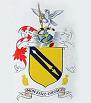
In Oct. 1596 after William Shakespeare's application to become a gentleman was denied, his father John Shakespeare was granted the Shakespeare Family Coat of Arms, consisting of "Gould, on a Bend, Sables, a Speare of the first Steeled Argent. And for his creast or cognizaunce a falcon, his winges dispplayed Argent standing on a wreath of his coullers", i.e., a yellow spear on a yellow shield, with the Latin inscription "Non Sans Droict", meaning "Not without Right".
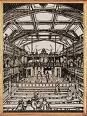
In 1596 James Burbage purchases the old Blackfriars Theatre in London (founded on the site of a 13th cent. Dominican monastery), whose lease was held in the mid-1580s by well-connected courtier and art patron Edward de Vere, 17th Earl of Oxford (1550-1604), but because of neighborhood pressure he couldn't use it for his company, so in 1599 it ends up being used by the pre-pubescent boys from the Chapel Royal under the name Children of the Chapel, who innovated with artificial lighting and music between acts while successfully charging high prices. In 1608 Burbage finally gets control again, and uses it for winter performances, with the Globe used during the summer. It is demolished on Aug. 6, 1655.
In 1596-7 Shakespeare wrote the history Henry IV, Pt. 1. Summary: Henry IV of England, his son Prince Hal, Hotspur (Henry Percy) (son of the earl of Northumberland), Sir John Falstaff, Welsh rebel Owen Glendower, English rebel Edmund Mortimer, Scottish rebel Earl of Douglas. "Sink or swim" (1.3.194); "I am not in the roll of common men" (3.1.43); "He was but as the cuckoo is in June,/ Heard, not regarded" (3.2.75); "My nearest and dearest enemy" (3.2.123); "The better part of valor is discretion" (5.4.130); "I have more flesh than another man, and therefore more frailty" (3.3.187); "The very life-blood of our enterprise" (4.1.28). In 1596-7 he also wrote Henry IV, Pt. 2; Falstaff has a total of 1,178 lines in Pts. 1 & 2. Summary: "It was always yet the trick of our English nation, if they have a good thing, to make it too common" (1.2.244); "He hath eaten me out of house and home" (2.1.82); "Let the end try the man" (2.2.53); "Is it not strange that desire should so many years outlive performance?" (2.4.283); "Uneasy lies the head that wears a crown" (3.1.31); "O God! that one might read the book of fate" (3.1.45); "There is a history in all men's lives" (3.1.80); "A man can die but once; we owe God a death" (3.2.253); "We see which way the stream of time doth run/ And are enforc'd from our most quiet sphere/ By the rough torrent of occasion" (4.1.70); "The wish was father, Harry, to that thought!" (4.5.91); "Before thy hour be ripe" (4.5.95); "Commit the oldest sins the newest kind of ways" (4.5.124); "His cares are now all ended" (5.2.3); "How ill white hairs become a fool and jester!" (5.5.52).
In 1596-7 Shakespeare also wrote the comedy The Merry Wives of Windsor; Falstaff has 436 lines, which would make his the role with the most lines if the 1,178 from "Henry IV, Pts. 1&2" are added). Summary: Falstaff, Master Ford and Mistress Ford, Master Page and Mistress Anne Page, Fenton, Doctor Caius, Sir Hugh Evans, Master Slender, Justice Shallow; "In despite of the teeth of all rhyme and reason, that they were fairies" (Falstaff) (5.5.126-7).
In 1597 Love's Labour's Lost became the first play pub. under William Shakespeare's name; financially fixed, he bought the timber-brick New Place on Chapel St. for £60 from William Underhill, "a praty howse of brike and tymbar" (John Leland, Itinerary, 1540) (with 10 fireplaces), the 2nd largest house in Stratford-upon-Avon, built in 1486 for his family by future lord mayor of London (1491-) Sir Hugh Clopton (1440-96); demolished in 1759 by Rev. Francis Gastrell.
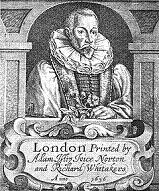
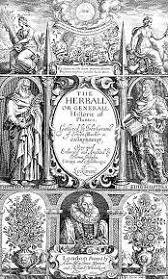
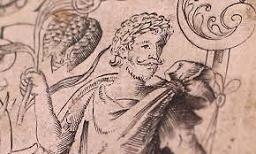
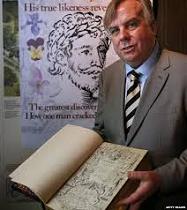
In 1597 Nantwich-born herbalist John Gerard (Gerarde) (1545-1612) pub. The Herball, or Generall Historie of Plantes (1,484 pages), becoming England's best known herbal; mentions Clusius in 1585 but not Raleigh in 1586 concerning potato cultivation in Europe; the title page has an engraving by William Rogers; on May 19, 2015 historian Mark Griffiths announces that it contains the only true portrait of William Shakespeare, at his prime (age 33).
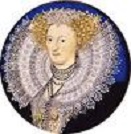
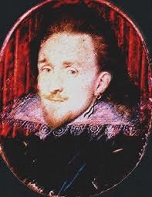
In 1597 widowed brain babe (poet, scholar, theologian) Mary Sidney Herbert, Countess of Pembroke (1561-1621) (brother of Sir Philip Sidney) met Shakespeare in her estate at Wilton, commissioning him to write 17 sonnets to persuade her son William Pembroke, 3rd Earl of Pembroke (1580-1630) to marry, after which she moved to London, while they became secret lovers until something made one of them pub. the sonnets, messing Shakespeare up after he's afraid to be outed and the public hates them?; is she the real author of the First Folio, her connections to executed traitor Lady Jane Grey and her gender causing her to have to use him as her front - stay tuned?
In 1598 English poet Richard Barnfield (1574-1620) pub. The Encomion of Lady Pecunia, in praise of money; also The Complaint of Poetry for the Death of Liberality; also Poems in Diverse Humours, incl. A Remembrance of Some English Poets, containing the first known praise of Shakespeare, comparing him to Edmund Spenser (1552-99), Samuel Daniel, and Michael Drayton; also If Music and Sweet Poetrie Agree, As It Fell Upon a Day in the Merry Month of May. In 1599 William Jaggard (1568-1623), a London publisher whose shop is "at the sign of the Half-Eagle in Barbican", and who later pub. Shakespeare's First Folio) pub. The Passionate Pilgrim, which contains 20 pieces attributed to "W. Shakespeare", of which only five really are?; some are claimed by rival poet Richard Barnfield, becoming his last work, after which dies in the London plagues.
In 1598-9 Shakespeare wrote the omedy, er, comedy Much Ado About Nothing, a pun on Much Ado About an O Thing, i.e., vagina, and Noting, i.e., overheard gossip. Summary: Prince Don Pedro of Arragon and his bastard brother Don Juan, Gov. Leonato of Messina and his niece Beatrice and her lover Benedick (bent his what on an O thing?), Leonato's daughter Hero and her lover Claudio, silly constable Dogberry. "I see, lady, the gentleman is not in your books (1.1.79); "I could not endure a husband with a beard on his face:/ I had rather lie in the woollen" (2.1.31); "As merry as the day is long" (2.1.52); "She speaks poniards, and every word stabs" (2.1.257); "I will tell you my drift" (2.1.406); ""To be a well-favored man is the gift of fortune, but to write and read comes by nature" (3.3.14); "There was never yet philosopher/ That could endure the toothache patiently" (5.1.35); "What though care killed a cat, thou hast mettle/ enough in thee to kill care" (5.1.135); "I was not born under a riming planet" (5.2.40).
In 1598-9 Shakespeare also wrote the history Henry V; Henry V has 1,025 lines, 5th most. Summary: Henry V of England, Charles of France and his daughter Princess Katherine ("Kiss me, Kate"), Welsh Capt. Fluellen, Pistol, Corporal Bardolph. "this wooden O" (Prologue 13); "That's the humor of it" (2.1.63); "As cold as any stone" (2.3.26); "I would give all my fame for a pot of ale, and safety" (3.2.14); "Men of few words are the best men" (3.2.40); "The fewer men, the greater share of honour" (4.3.22); "O Kate! Nice customs curtsy to great kings" (5.2.291).
In 1599 the Lord Chamberlain's Men built the 2.5K-seat open-roofed Globe Theatre (a 20-sided icosagon) in Southwark, London after Giles Allen, owner of the land under the N London Playhouse they had been performing in claimed to own the playhouse as well, causing them to dismantle the building at night and ferry it across the Thames to the S bank and rebuild it; Allen tried to take them to court but lost. On Sept. 18-Oct. 20, 1599 Swiss physician Thomas Platter the Younger (1574-1628) visited London theatres, and on Sept. 21 (2:00 p.m.) attended a performance of Shakespeare's "Julius Caesar" at the Globe Theatre, later writing about it and giving precious details, incl. the stench in the dog enclosure in the rear, where 120 English mastiffs are chained in separate kennels next to a stall with 12 large bears, one blind, and another stall with several bulls: "And the place was evil-smelling because of the lights [offal] and meat on which the butchers fed the said dogs."
In 1599 Shakespeare wrote the tragedy Julius Caesar; Brutus has 701 lines, 12th most; Caesar speaks less than 150 lines, and is murdered in Act 3 Scene 1. Summary: Julius Caesar and his wife Calphurnia, Mark Antony, Octavius Caesar, Marcus Brutus ("the noblest Roman of them all" - Antony, 5.5.68), Cassius ("Yon Cassius has a lean and hungry look; He thinks too much: Such men are dangerous" - Caesar), Lepidus; the 2nd of four Shakespeare plays to have a ghost on stage ("Great Caesar's ghost") (Richard III, Hamlet, Macbeth). "It was Greek to me" (Casca) (1.2.288); "... and there have sat/ The livelong day, with patient expectation,/ To see great Pompey pass the streets of Rome" (Marullus) (1.1.38-43); "Beware the ides of March" (1.2.18); "Why, man, he doth bestride the narrow world/ Like a Colossus" (Cassius) (1.2.133-4); "Cowards die many times before their deaths;/ The valiant never taste of death but once." (Caesar) (2.2.32-3); "I am constant as the northern star" (Caesar) (3.1.60); "Et tu, Brute? Then fall, Caesar" (Caesar's last words) (3.1.77); "Not that I loved Caesar less, but that I loved Rome more" (Brutus) (3.2.21); "Friends, Romans, countrymen, lend me your ears;/ I come to bury Caesar, not to praise him./ The evil that men do lives after them,/ The good is oft interred with their bones" (Antony) (3.2.79-82); "For Brutus is an honorable man;/ So are they all, all honorable men" (3.2.88-9); "Ambition should be made of sterner stuff" (3.2.98); "This was the most unkindest cut of all" (3.2.188); "Cry Havoc!, and let slip the dogs of war" (3.1.273); "Put a tongue/ In every wound of Caesar, that should move/ The stones of Rome to rise and mutiny" (3.2.232-3); "Forever and forever, farewell, Cassius!/ If we do meet again, why, we shall smile;/ If not, why then, this parting was well made" (5.1.117); "It is is impossible... to look without a revulsion... at this travestying of a great man as a silly braggart, whilst the pitiful gang of mischief-makers who destroyed him are lauded as statesmen and patriots" (George Bernard Shaw).
In 1599-1600 Shakespeare wrote the comedy As You Like It, based on Thomas Lodge's prose romance "Rosalynde" (1590); Rosalind has 668 lines, 16th most. Summary: Set in the Arden Forest in Warwickshire or the Ardennes in France; The Duke, his cross-dressing daughter Rosalind/Ganymede (most admirable Shakespeare character?) and her Herculean wrestler lover Orlando (son of Sir Rowland de Boys), the Duke's brother Duke Frederick, his attending lords Jaques (pr. likes Jakes) and Amiens, his courtier Le Beau, "motley fool" Touchstone the clown (truant court jester) (a touchstone to prove Rosalind's golden spirit), vicar Sir Oliver Martext, Orlando's brother Oliver and Rosalind's friend Celia/Aliena (daughter of Frederick), lovesick shepherd Silvius and Phoebe, old faithful servant Adam (played by Shakespeare?); "Sweep on, you fat and greasy citizens" (2.1.55); "I met a fool i' th' forest,/ A motley fool" (Jaques) (2.7.12-13); "All the world's a stage, and all the men and women merely players" (Jaques) (2.7.139-40); "Time travels in divers paces with divers persons" (3.2.328); "When a man's verses cannot be understood, nor a man's good wit seconded with the forward child, understanding, it strikes a man more dead than a great reckoning in a little room" (Touchstone) (3.3.9-11) (reference to Marlowe?); "Dead shepherd, now I find thy saw of might: "Who ever lov'd that lov'd not at first sight?" (3.5.91) (from Christopher Marlowe); "Men have died from time to time, and worms have eaten them, but not for love" (Rosalind) (4.1.103); "Why then, can one desire too much of a good thing?" (Rosalind) (4.1.116-7); "Men are April when they woo, December when they wed. Maids are May when they are maids, but the sky changes when they are wives" (Rosalind) (4.1.136-8).
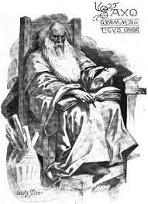
In 1599-1602 Shakespeare wrote the tragedy The Tragedy of Hamlet, Prince of Denmark, based on the story of Amleth in Gesta Danorum, a history of Denmark to 1187 in 16 vols. by Danish historian Saxo Grammaticus (1150-1220); a first vers. was written in 1588-93?; set in Elsinore (Helsingor) (site of Kronborg Castle); hammy Hamlet has 1,422 lines, most of any Shakespearean role; Shakespeare plays the ghost?; Ophelia's death is based on the death of Shakespeare's 5-y.-o. cousin Jane Shaxspere (-1569), whose lifeless body was found in a pond in Upton Warren, Worcestershire 20 mi. from Stratford-upon-Avon in 1569? Summary: Danish prince Hamlet avenges the murder of his father the king by killing evil uncle Claudius while fighting bipolar disease?; Prince Hamlet of Denmark, King Claudius of Denmark (Hamlet's uncle) and Queen Gertrude (Hamlet's mother), sententious advisor Polonius and his son Laertes and daughter (Hamlet's babe?) Ophelia (who goes mad); Norwegian Prince Fortinbras; Hamlet's loyal friend Horatio and disloyal friends Rosencrantz and Guildenstern; the fictitious play "The Murder of Gonzago"; "Some say that ever 'gainst that season comes/ Wherein our Saviour's birth is celebrated,/ This bird of dawning singeth all night long;/ And then, they say, no spirit dare stir abroad,/ The nights are wholesome, then no planets strike,/ No fairy takes, nor witch hath power to charm,/ So hallow'd and so gracious is the time." (1.1.11-17); "Not a mouse stirring" (1.1.10); "The memory be green" (1.2.2); "Frailty, thy name is woman!" (1.2.146); "It is not nor it cannot come to good" (1.2.158); "Thrift, thrift, Horatio! The funeral baked meats/ Did coldly furnish forth the marriage table" (Hamlet) (1.2.180-1); "In my mind's eye, Horatio" (1.2.185); "I doubt some foul play" (1.2.254); "Do not, as some ungracious pastors do,/ Show me the steep and thorny way to heaven,/ Whiles, like a puff'd and reckless libertine,/ Himself the primrose path of dalliance treads,/ And recks not his own rede" (1.3.51-5); "Neither a borrower nor a lender be,/ For loan oft loses both itself and friend" (Polonius) (1.3.75-6); "This above all: to thine own self be true,/ And it must follow, as the night the day,/ Thou canst not then be false to any man" (Polonius to Laertes) (1.3.78-82); "Something is rotten in the state of Denmark" (1.4.90); "Murder most foul, as in the best it is" (1.5.27); "Yea, from the table of my memory/ I'll wipe away all trivial fond records" (1.5.98-9); "Within the book and volume of my brain" (1.5.103); "One may smile, and smile, and be a villain" (1.5.108); "There are more things in heaven and earth, Horatio, than are dreamt of in your philosophy" (Hamlet) (1:5.166); "To put an antic disposition on" (1.5.172); "The time is out of joint" (1.5.188); "They say an old man is twice a child" (2.2.413); "The play, I remember, pleased not the million; 'twas/ caviare to the general" (2.2.465); "They are the abstracts and brief chronicles of the time" (2.2.555); "Oh! what a rogue and peasant slave am I" (2.2.584); "What's Hecuba to him or he to Hecuba,/ That he should weep for her?" (2.2.593); "Brevity is the soul of wit... More matter, with less art" (2.2.90-5); "The apparel oft proclaims the man" (Polonius); "There is nothing either good or bad, but thinking makes it so" (2.2.259); "This goodly frame, the earth, seems to me a sterile promontory" (2.2.317); "What a piece of work is a man! How noble in/ reason! how infinite in faculty! in form, in moving,/ how express and admirable! in action how like an/ angel! in apprehension how like a god!" (2.2.322-5); "The play's the thing/ Wherein I'll catch the conscience of the king" (Hamlet) (2.2.641); "To be, or not to be: that is the question/ Whether 'tis nobler in the mind to suffer/ The slings and arrows of outrageous fortune,/ Or to take arms against a sea of troubles,/ And by opposing end them?/... To die, to sleep;/ To sleep: perchance to dream: ay, there's the rub;/ For in that sleep of death what dreams may come/ When we have shuffled off this mortal coil/ Must give us pause" (Hamlet) (3.1.56-68); "The undiscover'd country from whose bourn/ No traveler returns" (3.1.79-80); "There's hope a great man's memory may outlive his life half a year" (3.2.141); "For 'tis a question left us yet to prove,/ Whether love lead fortune or else fortune love" (Player King) (3.2.197-8); "The lady doth protest too much, methinks" (3.2.242); "My words fly up, my thoughts remain below/ Words without thoughts never to heaven go" (Claudius) (3.3); "Oh shame! where is thy blush?" (3.4.82); "I must be cruel only to be kind" (3.4.178); "A man may fish with the worm that hath eat of a king,/ and eat of the fish that hath fed of that worm" (4.3.29); "We know what we are, but know what we may be" (4.5.43); "Alas! poor Yorick. I knew him, Horatio; a fellow of/ infinite jest, or most excellent fancy" (5.1.201-2); "Sweets to the sweet: farewell" (5.1.265); "And dog will have his day" (5.1.313); "There's a divinity that shapes our ends,/ Rough-hew them how we will" (5.2.10); "It did me yeoman's service" (5.2.36); "The rest is silence" (Hamlet's last words) (5.2.372); "Good night, sweet prince,/ And flights of angels sing thee to thy rest!" (5.2.373); an "artistic failure" (T.S. Eliot); "The only objection to Hamlet is that it exists" (Ralph Waldo Emerson).
About 1600 Anthony Munday writes the unproduced play The Book of Sir Thomas More, which contains material written by William Shakespeare, in which More tries to quiet riotous Londoners about to massacre immigrants with reasoned argument: "Would you be pleased/To find a nation of such barbarous temper/That, breaking out in hideous violence,/Would not afford you an abode on earth,/Whet their detested knives against your throats?"
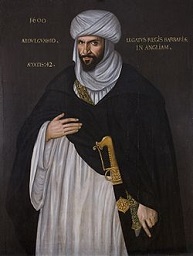
In Aug. 1600 after the English ship The Lion sails there and establishes the English Barbary Co. in 1585 to develop mutual trade, Abd al-Wahid (el-Ouahed) bin Mas'ud (ben Messaoud) bin Homammed (ben Mohammed) Anoun (b. 1558), ambassador of the king of Barbary (modern-day Morocco) arrives in London for a 6-mo. stay with Queen Elizabeth I, becoming the first Muslim and first Moor most people in London had ever seen, commonly described as black rather than swarthy; he meets with the queen on Aug. 19 and Sept. 10, seeking English help to invade Spain, and negotiations following through after she asks for an advance payment of 100K pounds; his portrait is painted while in England, ending up at the Shakespeare Inst. in Stratford-upon-Avon; three years later Shakespeare writes his famous play "Othello" about him?
In 1600 London theater mgr. Philip Henslowe and actor Edward Alleyn build the Fortune Theatre outside the city walls N of the Thames River on Golding (Golden) Lane outside Cripplegate in the Liberty of Finsbury to compete with the Globe Theatre, hiring Globe builder Peter Street to build the most luxurious public playhouse to date, changing the octagonal shape to rectangular and hiring the Admiral's Men as its resident co., going on to become the Globe's main rival, presentng plays by Ben Jonson et al. until the closing of the theaters in 1642, after which it is demolished in 1661.
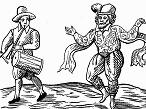
In 1600-8 William Shakespeare entered his Dark Vision Age. Meanwhile in Feb.-Mar. 1600 William Kempe (-1603), an actor in Shakespeare's plays (Falstaff) did his "Nine Daies Wonder", a Morris dance from London to Norwich in nine days spread over several weeks to cheering crowds.
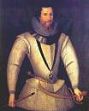
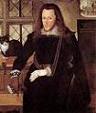

On Feb. 7, 1601 after Elizabeth's fallen favorite Robert Devereux, 2nd Earl of Essex (1565-1601) was placed under arrest for messing up a 1599 campaign against the Irish, Shakespeare and the Lord Chamberlain's Men were paid by Essex's Welsh friend Sir Gelly (Gelli) Meyrick (1556-1601) to stage a production of Richard II with its banned abdication scene at the Globe Theatre in Southwark in order to rouse the London pop.; on Feb.8 the half-baked tragicomical (Earl of) Essex Rebellion against old fart Elizabeth I (whom he claims he just wants to protect, assuming the title of Lord Protector after putting her under house arrest for her own good?) failed after the pop. doesn't go for it, and Lord Adm. Charles Howard et al. suppress the rebels; on Feb. 25 Essex was beheaded after "he acknowledged, with thankfulness to God, that he was justly spewed out of the realm"; Sir Walter Raleigh, who took part in suppressing the rebellion presided over the execution as capt. of the guard; four others were executed, 49 imprisoned or fined, and Lady Rich and 30 others set free; the popular songs Essex's Last Good Night and Sweet England's Pride Is Gone, Well-a-day, Well-a-day are born; on Feb. 12 Capt. Thomas Lee (1551-1601) was arrested in the palace kitchen on the way to the chamber where the queen sups, planning to force her at knifepoint to release Essex; he was tried at Newgate on Feb. 14 and hanged at Tyburn on Feb. 15 by Thomas Derrick, who invented a spar with a topping lift and pulleys for hanging, causing the word "derrick" to be coined; on Feb. 19 Shakespeare's handsome bi blue-eyed patron Henry Wriothesley, 3rd Earl of Southampton (1573-1624) was tried along with Essex for treason and condemned to death, but eventually released by James I.
On Mar. 13, 1601 English lawyer John Manningham (-1622) made an entry in his diary telling how actor Richard Burbage was playing Richard III in William's Shakespeare's play, and met a comely woman who invited him to her house, telling him to use the code name Richard III, but Shakespeare overhears her and goes in his place, later sending Burbage a bragging note "William the Conqueror was before Richard III" - should have said came before?
In 1601-4 William Shakespeare entered his Dark (Bitter) Comedy Age, producing three "dark comedies" "Twelfth Night", "All's Well That Ends Well", and "Measure for Measure".
In 1601 Shakespeare wrote the comedy (his funniest play?) Twelfth Night (What You Will), named after it debuted on Jan. 6, 1602 (Epiphany, manifestation of the Christ child to the Magi). Summary: Countess Olivia and her suitor Duke Orsino of Illyria on the E coast of the Adriatic, shipwrecked Viola/Cesario and her twin brother Sebastian, rescued by homoerotic Antonio (played by Shakespeare?), Olivia's drunken uncle Toby Belch, never-smiling steward Malvolio (satire of Ben Jonson and his comedy of the two humors, choler and blood, AKA Thanatos and Eros, the first of which causes fury, the second lust?), silly knight-suitor Sir Andrew Aguecheek, maid Maria, butler Fabian, and clown Feste; Viola pretends to be a eunuch named Cesario so she can work for her dream man Orsino, and when she attempts to convince his love Olivia (whose family died earlier, causing her to become an ice queen), it backfires and Olivia goes for him/her, suggesting a lez relationship that cannot be in this Jacobean era where everyone has a natural place; meanwhile drunken Toby Belch pushes Aguecheek on Olivia, and after a bunch of antics, where Maria fools Malvolio into thinking Olivia's in love with him with a fake letter, which causes him to get locked up in a dark room for lunacy, and Sebastian is confused with Cesario by Olivia, it all comes out right when Olivia marries Sebastian, Viola marries Orsino, and Belch marries Maria, restoring the natural order (it works just as good when Olivia pairs with Viola, and Sebastian with Orsino, and Antonio, Aguecheek, Fabian and Malvolio meet again in a gay bar?); Antonio ends up pairless after crying, "Which is Sebastian"; poor Malvolio is so mistreated he walks off swearing that he'll "be revenged on the whole pack of you". "If music be the food of love, play on" (Orsino) (1.1.1); "Love's night is noon" (Olivia) (3.1.162); "Then westward-ho!" (3.1.148); "Some are born great, some achieve greatness, and some have greatness thrust upon them" (Malvolio).
In 1601 Shakespeare wrote the comedy-tragedy Troilus and Cressida, which was not performed at the Globe because of the resemblance between Achilles and the Earl of Essex, or because lying "dog-fox" politician Ulysses resembles court personages. Summary: Trojan lovers Troilus and Cressida, who leaves him for Diomedes after being sent to the Greek camp in a POW exchange, after which Troilus' brother Hector is murdered by Achilles; Paris, Ulysses, Ajax, Margarelon (Priam's bastard son), Cressida's VD-infected pimp uncle Pandarus (source of the verb "to pander"), Greek slave Thersites ("a deformed and scurrilous Greek"); a speech by Ulysses to Achilles makes the word "fashionable" fashionable. "Men prize the thing ungain'd more than it is" (1.2.313); "This is the monstruosity in love, lady: That the will is infinite, and the execution confined: that the desire is boundless, and the act a slave to limit" (Troilus) (3.2.79-81); "The fractions of her faith, orts of her love... are given to Diomed" (Troilus) (5.2.157-9); "O, 'tis fair play" (Troilus) (5.3.40-43).
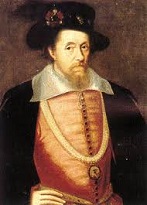
On Jan. 17, 1603 Elizabeth I dined with Lord Thomas Howard at the Charterhouse, and created him Lord Howard de Walden, then on Jan. 21 moved her court from Whitehall to "her warm winter box" of Richmond, wearing summer clothes in the cold weather, and telling Lord Nottingham, "My seat hath been the seat of kings, and I will have no rascal to succeed me; and who should succeed me but a king?"; on Feb. 6 she made her last public appearance, receiving Venetian envoy (first during her reign) Giovanni Carlo Scaramelli, speaking to him in Italian and gloating about scoring a coup against the pope by getting the Doge to recognize her after 45 years; on Feb. 16 she okayed a pardon for Irish rebel Hugh O'Neill, 2nd Earl of Tyrone, and attended the funeral of her cousin and closest female friend the Countess of Notthingham, daughter of Lord Hunsdon at Richmond, going into a depression and having to have her coronation ring sawed off after it became impacted, then wrote to Henry IV of France that "All the fabric of my reign, little by little, is beginning to fail"; on Feb. 26 she delayed a meeting with French ambassador de Beaumont; in Mar. she developed a fever, rallied on Mar. 11, relapsed on Mar. 12, refused medical treatment and food, lay on the floor on cushions in her clothes, developed pneumonia, and refused to be put in bed, explaining that "If she once lay down, she would never rise"; on Mar. 17 after being lifted into a low chair, and being helped to rise, she remained standing for 15 hours, then was helped back onto her cushions, remaining for 4 more days in 3-week-old clothes, then on Mar. 21 finally took to bed; meanwhile the rumors caused tons of people to head for Scotland to be with King James VI when the good, er, bad news arrived; after a bunch of woo woo woo stuff and giving her soul to Jesus she finally died before 3 a.m. on Mar. 24 (Thur.), lying on her back with her face to the wall "mildly like a lamb, easily, like a ripe apple from a tree, as the most resplendent sun setteth at last in a western cloud", according to her chaplain Dr. Parry; she died after viewing Hamlet, which debuted earlier in the year; at her death, there was not a single known English colonist in the New World (except possibly the lost colonists of Roanoke, who went injun). On Mar. 24, 1603 James I (1566-1625) (James VI of Scotland since 1567) became king of England, attempting in vain to unite Scotland with England, while dissing tobacco and sponsoring the King James Bible (1604-11), which Shakespeare probably helped with, at least the Psalms. He launched the Bible-thumping Jacobean Era, which saw England move into North America, starting with Jamestown, Virginia in 1607, Newfoundland in 1610, and Plymouth, Mass. in 1620.
On May 19, 1603 James I "licences and authorizes" Elizabeth I's Lord Chamberlain's Men, who were renamed the King's Men, and performed at the English royal court more than any other company, giving almost 200 performances in the next 10 years, modulo a little self-censorship to avoid boring or shocking kingey; James I visited Mary Sidney, who watched the King's Men perform. Too bad, in Dec. 1603 bubonic plague kills 33K in London (25% of the pop.), causing the theatres to be closed; on Nov. 1, 1604 William Shakespeare's Othello debuted at London's Whitehall Palace after the theaters are allowed to open. Also in 1603 the Mermaid Tavern in London was founded by Sir Walter Raleigh, and is frequented by literary wits including Shakespeare, Ben Jonson (1572-1637), Francis Beaumont (1584-1616), John Fletcher (1579-1625), John Donne (1572-1631) et al.
On July 19, 1603 after the "Main Plot" (dethronement of James I) was uncovered, naughty Sir Walter Raleigh (1552-1618) was arrested on charges of treason against James I and canned in the Tower, tried under commissioner Henry Howard, 1st Earl of Northampton, found guilty and sentenced to death, then reprieved 24 hours before the scheduled execution, spending the next 13 years there (until 1616), where he proceeded to research in alchemy and write The History of the World (1614).
In 1603-4 Shakespeare wrote the comedy Measure for Measure; Vincentio has 820 lines, 7th most). Based on "Promos and Cassandra" by George Whetstone. The title is an allusion to Christ's Sermon on the Mount ("With what measure yet mete, it shall be measured to you again"); the first play Shakey writes after giving up acting? Summary: Duke Vicentio of Vienna and dickteaser Isabella, Isabella's brother Claudio and Juliet, Angelo and Mariana, ducal advisor Escalus, rogue ("fantastic") Lucio and the whore Kate Keepdown, condemned murderer Barnardine; Vienna is a hotbed of lechery according to Duke Vicentio, so he entrusts supposedly pure Angelo to clean it up by enforcing a capital law against unmarried sex while pretending to leave town but actually disguising himself as a friar; Angelo condemns Claudio to death for doing it with his wife before marriage, causing his sister, wannabe nun Isabella to plead for him, but she's such a babe that he can't control his lusts and makes her decide between giving herself to him or having Claudio tortured, which she refuses even though Claudio says go for it; meanwhile he has rogue Lucio condemned for you know what with a whore; the disguised duke overhears it all and gets Angelo's past jilted lover Mariana to sub for Isabella in a bed trick, but Angelo orders Claudio executed anyway; happily, the duke gets the jailer to substitute condemned prisoner Barnardine for him, who refuses to be executed, then returns sansa disguise, straightens everything out, saves all the necks, and makes Angelo marry Mariana, Claudio marry Juliet, and Lucio marry his whore, then asks for Isabella's hand for himself, which she apparently consents to without saying anything?; "It is excellent to have a giant's strength, but it is tyrannous to use it like a giant" (Isabella) (2.2.107-9); "I swear I will not die today for any man's persuasion" (Bernardine) (4.3.59); "Haste still pays haste, and leisure answers leisure,/ Like doth quit like, and Measure still for Measure" (5.1.411); "What's mine is yours, and what is yours is mine" (5.1.539).
Also in 1603-4 Shakespeare wrote the tragedy The Tragedy of Othello, the Moor of Venice; Othello has 860 lines, 6th most, and Iago 1,094, 4th most; set in the Ottoman-Venetian war over control of Cyprus, which became a Venetian possession in 1489 until the port city of Famagusta fell to the Ottomans in 1571 after a protracted siege; based on the short story "Un Capitano Moro" (A Moorish Captain) in Cinthio's (disciple of Boccaccio) "Hecatommithi"; Summary: black Venetian Gen. Othello the Moor and his way younger white Venetian wife Desdemona, daughter of Brabantio, who marries him because "she did pity them" (1.3.169); "demi-devil" villain Iago, 3rd in command to Othello, who resents his promotion over his head of Cassio ("motiveless malignity" - Samuel Taylor Coleridge) escorts them along with his wife Emilia on a little jaunt to Cyprus to kick Turk butt, poisoning his mind about her by framing her hooking up with Cassio, causing Othello to murder her, find out that he was tricked, and stab and kill himself, with the soundbyte "One that loved not wisely, but too well"; Desdemona's former beau Roderigo. "An old black ram is tupping your white ewe" (1.1.88); "Play the villain" (2.3.345); "O beware, my lord, of jealousy/ It is the green-eyed monster, which doth mock/ That meat it feeds on" (3.3.165-7); "I am declined into the vale of years" (3.3.265); "But this denoted a foregone conclusion" (Iago) (3.3.429-30); "Pride, pomp and circumstance of glorious war" (3.3.355); "I hate the Moor" (Iago).
In 1605-6 Shakespeare wrote the tragedy (his best play?) King Lear; Lear has 697 lines, 13th most. Summary: Aging English King Lear asks his daughters Goneril (eldest) (bad) (wife of the Duke of Albany), Regan (Gael. "little king") (bad) (wife of the Duke of Cornwall), and Cordelia (Lat. "heart") (good) to tell him who loves him most, and the bad liars split faithful Cordelia's share of the kingdom, while she is exiled to France along with his former trusted adviser the Earl of Kent; the bad sisters then turn on daddy, take away his servants and force him to spend the night outdoors during a storm accompanied only by his jester the Fool, causing him to go mad, after which Cordelia returns and helps him restore his sanity, only to see the armies of the bad sisters capture them and kill Cordelia; Goneril then poisons Regan over a man they both love, then kills herself, leaving Lear mourning over the body of Cordelia; meanwhile the Earl of Gloucester banishes his good son Edgar in favor of bad son Edmund after he forges a document to ruin him, then Edmund has Regan's husband blind his father, causing him to see the er, light too late; "Nothing will come of nothing" (1.1.92); "Come not between the dragon and his wrath" (1.1.124); "The infirmity of his age" (1.1.296); "How sharper than a serpent's tooth it is/ To have a thankless child" (Lear) (1.4.312); "The prince of darkness is a gentleman" (3.4.147); "Do me no foul play, friends" (Gloucester) (3.7.30-31); "The wheel is come full circle" (5.3.176). In Nov. 1788 George III suffers a bout of mental illness after reading the play, causing the 1789 Regency Crisis, after which the play is no longer performed during his reign.
In 1605-6 Shakespeare and Thomas Middleton (1580-1627) wrote the tragedy Timon of Athens; Timon has 795 lines, 9th most. Summary: Timon and his faithful steward Flavius and false friend Vertidius, philosopher Apemantius, "planetary plague" Athenian Capt. Alcibiades.
In 1606 (1603-7) Shakespeare wrote the tragedy Macbeth; Macbeth has 681 lines, 15th most). Summary: Set in Dunsinane (Glamis) Castle 5 mi. S of Forfar in Angus; "a tempest set to music"; a ripoff of the Adam and Eve story, of course blaming Eve?; the Three Weird Sisters; King Duncan I "the Sick" (-1040) of Scotland and sons Malcolm (Malcom III Canmore) ("big head") (1031-93) and Donalbain (Donalbane) (Donald Bane) "the Fair" (-1099); "red king" (1040-57) Macbeth (-1057), thane (earl) of Glamis and Cawdor, and his goading ambitious wife Lady Macbeth (Gruoch), Macbeth's friend Banquo and his son Fleance, Macduff (loyal to Duncan), "untimely ripped from his mother's womb" (5.8.15-16) (Cesarian section?); "Macbeth shall never vanquish'd be until Great Birnam Wood to high Dunsinane Hill shall come against him" (4.1.92-3) (see 1054 C.E.); "So foul and fair a day I have not seen" (Macbeth) (1.3.38); "If it were done when 'tis done, then 'twere well/ It were done quickly" (Macbeth) (1.7.1-3); "I have no spur/ To prick the sides of my intent, but only/ Vaulting ambition, which o'erleaps itself/ And falls on th' other" (Macbeth) (1.7.25-28); "I am one, my liege,/ Whom the vile blows and buffets of the world/ Hath so incensed that I am reckless what/ I do to spite the world" (3.1.108-11); "Double, double, toil and trouble;/ Fire burn and caldron bubble" (4.1.10-11); "Bleed, bleed, poor country:/ Great tyranny, lay thou thy basis sure" (Macduff) (4.3.32-33); "What, all my pretty chickens, and their dam,/ At one fell swoop?" (Macduff) (4.3.218-9); "Out, damned spot!" (Lady Macbeth) (5.1.36); "Tomorrow, and tomorrow, and tomorrow/ Creeps in this petty pace from day to day,/ To the last syllable of recorded time;/ And all our yesterdays have lighted fools/ The way to dusty death. Out, out, brief candle!/ Life's but a walking shadow, a poor player/ That struts and frets his hour upon the stage/ And then is heard no more. It is a tale/ Told by an idiot, full of sound and fury/ Signifying nothing" (Macbeth) (5.5.19-28). That year Shakespeare's Macbeth debuted at Hampton Court before James I and his brother-in-law Christian of Denmark, and James I banned it for five years because of the witches.
In 1606 Shakespeare also wrote the tragedy Antony and Cleopatra; Antony has 766 lines, 10th most. Summary: Roman Gen. Mark Antony (ruler of the East) and his babe Queen Cleopatra of Egypt, Octavius Caesar (ruler of the West) and sister Octavia (Antony's wife), Lepidus (ruler of the South), Pompey; Cleopatra's attendant Charmian, who follows her to aspy death. "My salad days,/ When I was green in judgment" (Cleopatra) (1.5.73); "The triple pillar of the world transform'd/ Into a strumpet's fool" (1.1.12-13) (Philo, about Antony); "Ambition,/ The soldier's virtue" (3.1.22).
In 1606-7 Shakespeare wrote the comedy All's Well That Ends Well (last play in which Shakespeare acted?), based on "The Palace of Pleasure", tr. by William Painter. Summary: Bertram, Count of Rossillion marries adoring wife Helena (an orphan who was raised by his mother the Countess of Rossillion), then dumps her as too low class, writing her a letter saying that she can never call him husband unless she gets a ring from his finger and becomes pregnant by him, which she proceeds to do by taking the place of a girl he falls for; Lord Lafew, Diana, Parolles ("words"); "My friends were poor, but honest" (1.3.203); "They say miracles are past" (2.3.1); "A young man married is a man that's marr'd" (2.3.314); "The web of our life is of a mingled yarn, good and ill together" (4.3.68); "All's well that ends well; still the fine's the crown./ Whate'er the course, the end is the renown" (Helena) (4.4.35-6).
In 1607 Shakespeare and George Wilkins (1576-168) wrote the comedy Pericles, Prince of Tyre; only Shakespeare country title not in Europe; Pericles has 592 lines, 20th most. Summary: Pericles and his wife Princess Thalsa of Pentapolis, their daughter Marina, and their counselor Lord Helicanus; Tarsus Gov. Cleon, Lord Cerimon of Ephesus; Pericles is parted from his wife and daughter and presumes them dead, but reunites with them at the end; Pericles discovers the secret that King Antiochus had incest with his daughter Thalsa.
In 1607-8 (1605-8?) Shakespeare wrote the tragedy The Tragedy of Coriolanus; Coriolanus has 809 lines, 8th most). Summary: Set in 490 B.C.E.; Roman Gen. Caius Martius (Coriolanus), his mother Volumnia and friend Menenius Agrippa, Rome's sole consul Gen. Cominius (no tribunes), Volscian Gen. Tullus Aufidius (Coriolanus' enemy); Corioli is the Volscian city that you-know-how single-handedly conquers, then is banished from Rome, joins his enemies, and returns, being talked out of it at the last moment by mommy, causing the Volscians to kill him. "Action is eloquence" (3.2.76) (Volumnia).
In Aug. 1608 the King's Men took over the roofed-in Blackfriars Theatre, which was smaller than the Globe but could stage performances at night and in winter and charge more; in Sept. (momma's boy?) William Shakespeare's mother Mary died, and he entered his Fancy Free Age (1608-13).
In 1609-10 Shakespeare wrote the comedy The Winter's Tale; Leontes has 648 lines, 17th most. Summary: King Leontes of Sicilia and his wife Queen Hermione, son Prince Mamillius, and daughter Perdita ("marooned"), who is marooned on "the sea-coast of Bohemia"; King Polixenes of Bohemia and his son Prince Florizel; thief Autolycus, Sicilian lord Antigonus and his wife Paulina; Leontes' advisor Camillo, who refuses to poison Polixenes and helps him escape after Leontes gets jealous of Polixenes, thinking he's hooking up with his wife Hermione, with Leontes uttering the soundbyte: "And many a man there is, even at this present,/ Now while I speak this, holds his wife by th'arm,/ That little thinks she has been sluiced in's absence/ And his pond fished by his next neighbor, by/ Sir Smile, his neigbor" (1.2.192-6); after Polixenes escapes, Leontes imprisons Hermione and has her newborn child Perdita abandoned, after which Mamillius dies pining for his mother Hermione, who dies of a broken heart, after which Leontes wakes up, and tries to find Perdita in vain, after which she grows up and hooks up 16 years later with Florizel, is revealed as Leontes' daughter, and Perdita is found to be playing a statue to keep away from him, but now hooks back up with him, for a happy ending, except for Mammilius; "You pay a great deal too dear for what's given freely" (1.1); We were, fair queen,/ Two lads that thought there was no more behind/ But such a day to-morrow as to-day,/ And to be boy eternal/... We were as twinned lambs that did frisk i' the sun,/ And bleat the one at the other: what we changed/ Was innocence for innocence; we knew not/ The doctrine of ill-doing, nor dream/d/ That any did/... 1.2.78-87) (Polixenes to Hermione about him and Leontes in their youth); "But to be paddling palms and pinching fingers,/ As now they are, and making practised smiles,/ As in a looking-glass" (Leontes) (1.2.115-7); "How like, methought, I then was to this kernel, This squash, this Gentleman" (1.2); "A sad tale's best for winter: I have one/ Of sprites and goblins" (Mamilius) (2.1.25-26); "It is a heretic that makes the fire,/ Not she who burns in 't" (2.3); "I am a feather for each wind that blows" (2.3); "What's gone and what's past help/ Should be past grief" (3.2.223-4) (Paulina to Hermione); "Exit, pursued by a bear" (meaning Antigonus) (3.3.58); "For the red blood reigns in the winter's pale" (Autolycus) (4.3.4); "A snapper-up of unconsidered trifles" (Autolycus) (4.3.1); "Though I am not naturally honest, I am so sometimes by chance" (Autolycus) (4.4.712-3); "I love a ballad in print o'life, for then we are sure they are true" (4.4); "To unpathed waters, undreamed shores" (4.4); "'Tis time; descend; be stone no more; approach" (Paulina to the statue of Hermione) (5.3.99).
Also in 1609 the quarto ed. of Shakespeare's Sonnets was pub.. ""When forty winters shall seige thy brow,/ And dig deep trenches in thy beauty's field" (Sonnet 2, line 1); "Everything that grows/ Holds in perfection but a little moment" (Sonnet 15, line 1); "Shall I compare thee to a summer's day?/ Thou art more lovely and more temperate./ Rough winds do shake the darling buds of May,/ And summer's lease hath all too short a date." (Sonnet 18, lines 1-4); "Clean starved for a look" (Sonnet 75, line 10); "Lillies that fester smell far worse than weeds" (Sonnet 94, line 14); "To me, fair friend, you never can be old,/ For as you were when first your eye I ey'd,/ Such seems your beauty still" (Sonnet 104, line 1); "For I have sworn thee fair, and thought thee bright,/ Who art as black as hell, as dark as night" (Sonnet 147, line 13).
In 1609 the first English Copyright Act of 1709 (Statute of Anne) grants owners 14 years of protection on their works, effective Apr. 10, 1710, causing English publisher Jacob Tonson the Elder (1655-1736) (founder of the Kit-Cat Club) to purchase the copyright to Shakespeare's Fourth Folio.
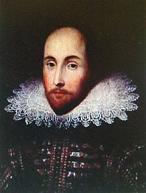
About 1610 the Cobbe Portrait of William Shakespeare is painted, owned by Anglican archbishop of Dublin Charles Cobbe (1686-1765), who passes it down, becoming publicly known in 2006; once attributed to artist Cornelis Janssens van Ceulen (1593-1661); several copies are made with different hairlines, all the way from bald to prime of life; really Sir Thomas Overbury?; ends up in the Folger Shakespeare Library.
In 1610-11 Shakespeare wrote the comedy The Tragedy of Cymbeline, King of Britain. Summary: Cymbeline, Celtic king of Britain and his queen, Posthumous and Imogen, Pisanio, Cloten, Belarius, Guiderius (Polydore), Arviragus (Cadwal), Iachimo. "Hath his bellyful of fighting" (2.1.24); "Hark! hark! the lark at heaven's gate sings" (2.3.22); "The game is up" (3.3.107); "Slander,/ Whose edge is sharper than the sword" (3.4.35); "I have not slept one wink" (3.4.103).
In 1610-11 Shakespeare wrote the comedy The Tempest for the marriage of German "Winter king" Friedrich V and Elizabeth of Bohemia; his last play written without the collaboration of John Fletcher; the first play in the First Folio; Prospero has 603 lines, 19th most; Summary: Prospero (duke of Milan) ("the favored one") (It. trans. of Faustus), Miranda, Alonso, Ferdinand, Antonio, Sebastian, Ariel (Heb. "lion of God") (a sprite), "savage and deformed slave", "howling monster", "drunken monster", "most scurvy monster" Caliban (father is a sea devil, mother is the Algerian witch Sycorax), Trinculo; "Full fathom five thy father lies./ Of his bones are coral made./ Those are pearls that were his eyes./ Nothing of him that doth fade,/ But doth suffer a sea-change/ Into something rich and strange/ Sea-nymphs hourly ring his knell"; "Our revels now are ended. These our actors,/ As I foretold you, were all spirits, and/ Are melted into air, into thin air" (Prospero) (4.1.148-50); "How beauteous mankind is! O brave new world, /That has such people in 't!" (Miranda) (5.1.183-4); "strange bedfellows" (Trinculo and Caliban) (2.2). In 1878 French writer Ernest Renan (1823-92) pub. Caliban, claiming that Caliban represents democracy, Prospero autocracy, and Ariel the religious establishment, which flourishes in the service of Prospero under the govt. of the many-headed brute Caliban. The 1956 film Forbidden Planet, starring Walter Pidgeon, Leslie Nielsen, and Anne Francis is based on this play.
In 1611 the govt.-sponsored King James Bible was pub., becoming a dud with Puritans but forced into all Anglican churches by royal decree, giving them no choice, which turns out well because the language is so beautiful; Psalm 46 features word 46 from the beginning "shake" and word 46 from the end "spear", and of course William Shakespeare (b. 1564) is 46 the first part of this year; a tribute, or did he translate it? - it's a pajama people special?
In 1612-13 Shakespeare and John Fletcher (1579-1625) wrote the comedy The History of Cardenio, based on Miguel Cervantes' "Don Quixote"; it is now lost; in 2010 English prof. Brean Hammond claimed that Lewis Theobald's 1727 play "Double Falsehood" is based on it, like he claimed all along.
Also in 1612-13 Shakespeare and Fletcher wrote the history Henry VIII, or All Is True.; "No man's pie is freed/ From his ambitious finger" (1.1.52); "The mirror of all courtesy" 2.1.53); "I would not be a queen/ For all the world" (2.3.45); "Press not a falling man too far" (3.2.334).
In 1613 Shakespeare and Fletcher wrote the comedy The Two Noble Kinsmen. Summary: Theseus, Duke of Athens and Hippolyta, Queen of the Amazons, Emilia, Palamon, and Arcite. "O grief and time,/ Fearful consumers, you will all devour!" (1.1.69-70);
On June 29, 1613 the Globe Theatre in Southwark, London burned down in two hours after a loose dick, er, tom, er cannon was set off during a performance of Shakespeare's "Henry VIII"; no one was hurt and the Globe was rebuilt in June 1614, and closed in 1642. Too bad, in 1610 at the pinnacle of his career Shakespeare retired to New Place in Stratford-upon-Avon, also buying a house in Blackfriars; John Fletcher took over as the house playwright for the King's Men - from spears to arrows?
In Feb. 1616 William Shakespeare's and Anne Hathaway's daughter Judith Shakespeare (1585-1662) married Thomas Quiney (1589-1663), a vintner in Stratford-upon-Avon; they had sons Shakespeare Quiney (1616-17), Richard Quiney (1617-39), and Thomas Quiney (1619-39).
On Apr. 23, 1616 (his birthday?) well-to-do retired William Shakespeare (b. 1564) died of fever in Stratford-upon-Avon, Warwickshire, leaving 39 plays, 154 sonnets, two long narrative poems et al.; he coined 6.7K (3K?) English words; his vocabulary was 17K-29K words, and he used 7K+ different words only once; Anglican Archdeacon Richard Davies of Lichfield, who had known him later wrote that he had been a secret (illegal) Roman Catholic; his last will and testament leaves the bulk of his estate to his daughter Susanna and her husband, leaving his "second best bed with the furniture [bedclothes]" to his wife; his literary work isn't mention in his will; he was buried in the same place where he had been christened, Holy Trinity Church in Stratford-upon-Avon; his epitaph is "Curst be he that moves my bones", keeping him from being buried in Westminster Abbey?; his grave marker shows him holding a bag of grain, which is changed to a quill in 1747; in 2001 the Journal of Science pub. an analysis of clay pipe fragments dug up from his garden, revealing residues of marijuana, cocaine, and myristic acid; he died from mercury poisoning from treatment for syphilis?
In 1616 Wurttemberg-born theologian Johann Valentin Andreae (1586-1654) anon. pub. Chymische Hochzeit Christiani Rosenkreutz Anno 1459 (The Chemical Wedding of Christian Rosenkreutz in 1459 C.E.) in Strasbourg, one of the three founding works of the Rosicrucians (1614, 1615); Sir Francis Bacon (who is suspected of being the real Shakespeare) is a Rosicrucian, as are many of Shakespeare's plays?; Andreae later claims authorship in his autobio., and calls it a "ludibrium" (lampoon).
In 1616 Ben Jonson (1572-1637) pub. Works (Folio Ed.), the first folio ed. of its kind, setting a precedent used for Shakespeare's plays in 1623, and Beaumont and Fletcher's plays in 1647.
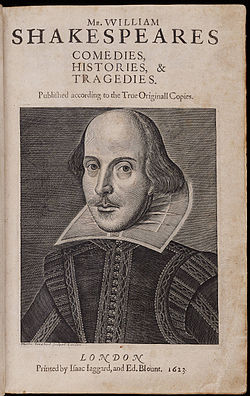
In Nov. 1623 the posth. First Folio (Mr. William Shakespeares Comedies, Histories, & Tragedies, Published According to the True Originall Copies), is pub. in London, ed. by fellow actors John Heminges (1556-1630), and Henry Condell (-1627); contains 36 plays; Preface by Ben Jonson; "an office to the dead, to procure his orphans' guardians", "to keep the memory of so worthy a friend and fellow alive as was our Shakespeare"; dedicated to Jonson's patron William Herbert, 3rd Earl of Pembroke (1580-1630) (chancellor of Oxford U.) and his brother Philip Herbert, 4th Earl of Pembroke (1584-1650); the title page engraving of WS by Brussels-born Martin Droeshout (1601-51) was drawn from instructions only, since he never saw his subject, and was 15 when Shakespeare died; the "monstrous" drawing of Big S is oddly assymetrical, with a funny line behind his ear down to his chin, as if he has a mask on, giving conspiracy theorists plenty to munch on; the Chandos Portrait of William Shakespeare by John Taylor (1585-1651), painted in 1600-10 is the only contemporary portrait; in 1856 it becomes the first acquisition of the Nat. Portrait Gallery in London; "The play's the thing... look not on his picture but his book"; "He was not of an age, but for all time!"; "Soul of the Age! The applause, delight, the wonder of our stage!"; "Take him and cut him out in little stars/ And he will make the face of heaven so fine,/ That all the world will be in love with night"; "Our Star of Poets" (Ben Jonson); by the 21st cent. only 40 copies survive; on Oct. 8, 2001 one sold at a New York City Christie's Auction for $6,166,000; on July 13, 2006 Sotheby's auctioned one for $5.2M. On Dec. 5, 1623 Sir Edward Dering, 1st Baronet (1598-1644) became the first person to buy a copy of the First Folio (two copies at 2 pounds each, along with a vol. of Ben Jonson for 9 shillings), producing an amateur production of "Henry IV" parts 1 and 2 in a household in Pluckley, Kent this year, becoming the first amateur performance of a Shakespeare play.
After Shakespeare died, his works made him a god to millions, causing Shakespeare Memorials to be erected, starting with a funerary monument in Stratford-upon-Avon in 1623, a statue of him in Poets' Corner in Westerminster Abbey in 1740, and another statue in Central Park in New York City in 1872.

Too bad, at first the mass reading of the King James Bible caused the pleasure-hating Bible-thumping movement of Puritanism to spread. Already in 1623 William Prynne (1600-69) pub. Histrio-Mastix (Histriomastix): The Players Sourge, or Actors Tragedie, detailing how the Bible proves "that popular stage-playes are sinfull, heathenish, lewde, ungodly spectacles, and most pernicious corruptions". The English Civil War in 1642-51 was a V for the the Puritan Roundheads (Parliamentarians) over the Anglican Cavaliers (Royalists), putting a Bible police state in power that shut down the theaters until the death of leader Oliver Cromwell (1599-1658), yes, it was Shakespeare against the Bible.

In Sept. 1642 the Puritan Parliament wastes no time 'getting' Shakespeare, forbidding all stage plays and closing all theatres; Christmas is banned in England by the mirthless Puritans, incl. taking the day off from work, decorating with greens, and mince pies (first brought back from the Middle East by 13th cent. Crusaders) for associations with Roman Catholic idolatry; the theaters don't reopen until 1660 - so I quit the police department and got myself a steady job?
In 1660 the theatres in London (closed 1642) finally reopen; actresses first appear on English and German stages, replacing boys; Margaret "Peg" Hughes (Hewes) (1630-85) is the first, becoming the first English prof. stage actress, debuting on Dec. 8 as Desdemona in "Othello" (played by Clare Market), produced by Charles I's former page boy Thomas Killigrew (1612-83) and his new King's Company (chartered Aug. 21) (closes 1682) at the Vere St. Theatre; Sir William Davenant forms the Duke of York's Players (Duke's Co.), performing his own works plus those of William Shakespeare, Ben Jonson, and John Fletcher, causing people to believe he's really Shakespeare's son.
On Feb. 5, 1663 England's top poet (poet laureate in 1668), Northamptonshire-born John Dryden (1631-1700) and Sir William Davenant D'Avenant (1606-68) debut their comedy The Tempest, or The Enchanted Island at the Duke's Theatre in Lincoln's Inn Fields, London, based on William Shakespeare's "The Tempest".
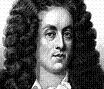
In 1681 Irish poet Nahum Tate (1652-1715) debuted "The Sicilian Usurper", his version of Shakespeare's "Richard II", altered to be "full of respect to Majesty and the dignity of courts", which didn't stop it from getting suppressed. His 1681 The History of King Lear omits the Fool and has Cordelia and Edgar marry and live happily ever after, attending the elderly king until his death; it took until 1838 to reintroduce the Fool, played by a woman. Tate's 1682 version of "Coriolanus" was titled "The Ingratitude of a Commonwealth". He became British poet laureate in 1692.
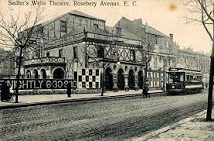
In 1683 Sadler's Wells Theatre on Rosebery Ave. in Clerkenwell, C London (cap. 1,560) opened, named after owner Richard Sadler and the monastic springs on the site, becoming the 2nd theater opened in London after the Restoration after Theatre Royal in Drury Lane, opening on Easter Monday and closing after summer; it was rebuilt in 1765; in 1843 after passage of the 1843 Theatres Act, new mgr. Samuel Phelps (1804-78) saved it from bankruptcy by introducing productions of Shakespeare that return to the text of the First Folio, starting with "Macbeth" in 1844, becoming the debut of actress Isabella Glyn (1823-89); in 1875 it became a roller skating rink, followed by a boxing arena; in 1879 it reopened as a music hall, featuring Harry Champion, Marie Lloyd, Roy Redgrave et al.; in 1896 it became a cinema; it closed in 1915.
In 1690 English antiquarian John Aubrey (1626-97) pub. Aubrey's Brief Lives, short pithy bios. of Tudor and Jacobean figures, pub. anon. until 1813; he writes about "Mr. William Shakespeare" that "His father was a butcher, and I have been told heretofore by some of the neighbors that when he was a boy he exercised his father's trade, but when he killed a calf he would do it in a high style and make a speech".
In 1709 Bedfordshire, England-born poet-playwright Nicholas Rowe (1674-1718) pub. Stage Edition of Shakespeare (6 vols.); the first to divide the plays into scenes and acts, with entrances/exits noted, to normalize the spelling of names, and to prefix a list of dramatis pesonae; first ed. of Shakespeare to be illustrated; incl. a bio. by Rowe; too bad, he uses the corrupt Fourth Folio.
In 1725 London-born heroic couplet master Alexander Pope (1688-1744) pub. a new ed. of Shakespeare's works, which "regularized" the meter and changed the verse in several places, demoting 1560 lines to footnotes for being "excessively bad".
In 1726 Sittingbourne, Kent-born Lewis Theobald (1688-1744) pub. Shakespeare Restored, or a Specimen of the many Errors as well Committed as Unamended by Mr Pope in his late edition of this poet; designed not only to correct the said Edition, but to restore the true Reading of Shakespeare in all the Editions ever published, a variorum ed. of Shakespeare's works in reaction to Alexander Pope's 1725 ed., pointing out many errors that Pope grudgingly acknowledges by changing his 2nd ed. in 1728, while only admitting to "about twenty-five words", knocking Theobald in his anon. 1728 work "The Dunciad"; in 1733 Theobald pub. a 2nd ed. in 7 vols., which becomes a std. work.
In 1726 after pissing-off some aristocrats, French lit. giant Voltaire (Francois-Marie Arouet) (1694-1778) is exiled in Britain (until 1728), living at 10 Maiden Lane in Covent Garden, London, where he develops an interest in the works of Shakespeare, which are still relatively unknown in Europe, admiring them for having more on-stage action than French plays; too bad, as Shakespeare becomes popular in France, he gets jealous, dissing him for his barbarities and trying to set his own plays up as a counterexample; in May he meets 83-y.-o. Isaac Newton in London, and may have attended his funeral - and discussed the secret formula for eternal life?
In 1728 London-born heroic couplet master Alexander Pope (1688-1744) anon. pub. The Dunciad (3 vols.) in Dublin, a satire of witless critics, using initials for the targets, with Lewis Theobald ("Tibbald") (who pub. a criticism of his 1725 ed. of Shakespeare in 1726) as King of Dunces, appointed by the goddess Dulness to succeed Elkannah Settle on Lord Mayor's Day in 1724 to degenerate Great Britain; goes after George II with "Still Dunce the second rules like Dunce the first", and takes on Protestants, Whigs, and hack writers Daniel Defoe (1659-1731), Ambrose Philips (1674-1749), Nahum Tate (1652-1715), Thomas Heywood (1570-1641), and Sir Richard Blackmore (1654-1729), also Susanna Centlivre (1667-1723), who stays awake through a reading of Richard Blackmore's boring epics longer than anyone except Folly; "Books and the Man I sing, the first who brings/ The Smithfield Muses to the Ear of Kings" (opening); "How, with less reading then makes felons 'scape,/ Less human genius than God gives an ape,/ Small thanks to France and none to Rome or Greece,/ A past, vamp'd, future, old, reviv'd, new piece,/ 'Twixt Plautus, Fletcher, Congreve, and Corneille,/ Can make a Cibber, Johnson, or Ozell" (1.235-40); causes a big reaction, creating a ton of lifelong enemies, who love to slander him, which isn't hard to do?; he begins taking his Great Dane attack dog Bounce with him while walking, with loaded pistols in his pocket; a satirical print from "Pope Alexander" pub. in 1729 portrays him as an ape wearing papal vestments, suggesting Darwin's Theory of Evolution?; in 1729 he anon. pub. "The Dunciad Variorum", followed in 1742 by "The New Dunciad", and in 1743 by "The Dunciad in Four Books", with Bays replacing Tibbald.
In 1740 Dublin, Ireland-born Margaret "Peg" Woffington (1720-60) made her stage debut in Covent Garden, London as Sir Harry Wildair in George Farquhar's "The Constant Couple", and went on to star there and at Drury Lane, specializing in female roles requiring male clothing, becoming the mistress and co-star of Hereford, England-born David Garrick (1717-79), who this year debuted his first play Lethe; or, Aesop in the Shade at the Theatre Royal in Drury Lane, London, followed in 1741 by The Lying Valet: A Peep Behind the Curtain; Or, the New Rehearsal. On Oct. 19, 1741 Hereford, England-born David Garrick (1717-79), pupil of Irish actor Charles Macklin (1697-1797) made his acting debut in Thomas Southerne's "Oroonoko or the Royal Slave" in Ipswich, followed by the title role in Shakespeare's "Richard III" in Goodman's Fields, London, displaying a new more realistic acting style that makes him a star, appearing in 18 different roles in 6 mo. in London's Drury Lane and Covent Garden; his career raises acting to a more respected profession; Charles Fleetwood hires him for a season at the Theatre Royale in Drury Lane, London, where he remains for five years. In 1747 Garrick became co-owner and co-mgr. of Drury Lane Theatre, enforcing his own acting style on all the actors and creating an ensemble, ending the custom of letting the privileged sit on the stage, and producing 24 Shakespeare plays - I was completely in tears until I clicked? On Sept. 6-8, 1769 famed Shakespearean actor David Garrick (1717-79) organized the first Shakespeare Jubilee in Stratford-upon-Avon, which thousands brave rainy weather to see, causing him to build the Shakespeare Pavilion (cap. 1K); too bad, none of Shakespeare's plays are performed; he and English #1 composer Thomas Arne (1710-78) compose the song Soft Flowing Avon; for the Jubilee. On Oct. 14, 1769 after his big Jubilee pageant is rained-out on Sept. 8, Garrick debuted The Jubilee at Drury Lane Theatre in London (90 perf.), its success allowing him to recoup his losses. In June 1776 after selling his interest in Drury Lane Theatre and giving a series of farewell performances in favorite roles, David Garrick appeared in The Wonder: A Woman Keeps a Secret (1714) by Susanna Centlivre (Carroll) (nee Freeman) (1667-1723), becoming his last stage appearance.
In 1748 Parson Joseph Greene, master of Stratford-upon-Avon Grammar School in England organized the first recorded performance of a play ("Othello"?) by William Shakespeare in his hometown to fund the restoration of his funerary monument, performed by the Warwickshire Co. of Comedians in Birmingham.
About 1750 the first Broadway Theatre was founded on Nassau St. in Manhattan by actor-mgrs. Walter Murray and Thomas Kean, performing Shakespeare plays and ballad operas incl. "The Beggar's Opera" (1728). Meanwhile prudish Puritan Boston, Mass. passed the Puritans' Act of 1750, prohibiting theatrical performances, causing it to lag far behind New York City, Charleston, Providence, and Philly; on Sept. 29, 1769 a brave soul gave a public reading of "The Beggar's Opera", calling it a "moral lecture"; the act was abolished in 1799 after the Board Alley opened in 1792 and took all the heat.
In 1752 the first major prof. theatrical co. in British Am. opened in Williamsburg, Va. under the mgt. of Lewis Hallam (1712-58), touring from the Carolinas to New England and introducing David Garrick's acting style.
In 1755 London-born Frances "Fanny" Abington (nee Barton) (1737-1815) debuted as Miranda in Susanna Centlivre's "Busybody" in Haymarket, London, getting her a recommendation by Samuel Foote to join the Drury Lane co., remaining for 18 years and becoming the first to play 30+ important chars., incl. Shakespeare's Beatrice, Desdemonia, Ophelia, and Portia, and Lady Teazle in 1777.

How did Shakespeare fare in Krautland Germany? In 1759 German dramatist-critic Gotthold Ephraim Lessing (1729-81) founded the critical journal Briefe, die Neueste Literatur Betreffend with Moses Mendelssohn and Christoph Friedrich Nicolai, which pub. essays promoting Shakespeare as a model for German dramatists in preference to Frenchies such as Corneille, Racine, and Voltaire, causing German literati to cast off French influence. In 1762-6 German poet Christoph Martin Wieland (1733-1813) translated 17 Shakespeare plays into German in 8 vols., becoming the first look the Krauts got at the Anglo-Saxon god, I guess they didn't buy it else there might not have been WWI and WWII. In 1775-82 German Anglophile scholar Johann Joachim Eschenburg (1743-1820) pub. William Shakespeare's Plays (13 vols.) in Zurich, based on the 1762-6 tr. by Christoph Martin Wieland, becoming the first complete trans. in German prose of Shakespeare's plays. In 1797 German Romantic poet August Wilhelm von Schlegel (1767-1845) began translating Shakespeare into German, which is like translating silk purses into sows' ears. No surprise, in 1831 German dramatist Christian Dietrich Grabbe (1801-36) pub. Comedy, Satire, Irony and Deeper Meaning, dissing Germany's fascination with Shakespeare, and that was pretty much all she wrote for English culture stopping Hitler.
On Oct. 10, 1765 English writers Dr. Samuel Johnson (1709-84) and George Steevens (Stevens) (1736-1800) pub. The Plays of William Shakespeare (8 vols.), containing Johnson's famous Preface.
Also in 1769 Jean-Francois Ducis (1733-1816), whose own first tragedy "Amelis" was a flop in 1768 produced Shakespeare's "Hamlet" in Paris, relying on a fractured French trans. and achieving a success, causing him to crank out "Romeo and Juliet" (1772), "Macbeth" (1783), and "Othello" (1792), all with fractured French; but France is a family company, so vive la France?
Also in 1769 English Bluestockings founder Elizabeth Montagu (1718-1800) pub. An Essay on the Writings and Genius of Shakespear; pub. anon until 1777; extols Shakespeare to the skies as the greatest poet of all time while dissing Voltaire; "I was incited to this undertaking by great admiration of his genius, and still greater indignation at the treatment he has eceived from a French wit."

In 1773 Johann Wolfgang von Goethe (1749-1832), Johann Gottfried von Herder (1744-1803), and Justus Moser (Möser) (1720-94) pub. Von Deutscher Art und Kunst: Einige Fliegende Blatter (Blätter) (Of German Art and Style: A Loose Leaf), the manifesto of the German Sturm und Drang (Ger. "storm and stress", "storm and urge") Romantic movement, which digs on German folk songs, Gothic architecture, and Shakespeare, and lasts until the early 1780s.
On Jan. 8, 1776 English Roman Catholic actor John Philip Kemble (1757-1823) debuted as as Nathaniel Lee's "Emperor Theodosius" in Wolverhampton, going on to become one of the top Shakespearean actors of his day, #3 behind Edmund Kean and David Garrick, although his Macbeth tops theirs?
In 1785 Rev. James Wilmot (1726-1808) of Warwickshire, England claimed that well-situated Francis Bacon (1561-1626) was the real author of Shakespeare's plays, the original lone gunman theory. No surprise, by the 19th cent. the Shakespeare Authorship Question became the rage, questioning the legitimacy of the new god, after all he was just an ill-educated dummy corporation and stage manager who was the front for a New World Order conspiracy, right, with 70+ alternative real author candidates proposed, particularly Francis Bacon, 1st Viscount Albans (1561-1626), Christopher Marlowe (1564-93), William Stanley, 6th Earl of Derby (1561-1642), and Edward de Vere, 17th Earl of Oxford (1550-1604). Actually, it makes sense that England, which had discovered that it was in a great position to take over and colonize the world and impose English language and culture, had need of an Apollo Project to create both a Holy Bible and a Secular Bible that it could browbeat the non-white subject peoples with, hence they would have a motive to use "Shake-Spear" as a front, perhaps taking his original plays and reworking them to higher standards for the First Folio. If so, it was a coverup, so they destroyed all the evidence which could be used against them in court. And it was a successful conspiracy, especially after their wayward child America replaced them as the world's leader after WWII and spread English farther than ever, resulting in the ultimate triumph of the all-English World Wide Web, as Muhammad said, War Is Deceit.
In 1786 future U.S. presidents Thomas Jefferson and John Adams visited Stratford-upon-Avon, England, and chipped off a piece of Shakespeare's chair as a souvenir.
In 1786 after reading Eschenburg's German translations of Shakespeare, Russian empress (1762-96) Catherine II the Great (1729-96) debuted her play This It Is to Have Linen and Buck-Baskets, an adaptation of Shakespeare's "The Merry Wives of Windsor" at the new Hermitage Theater in St. Petersburg, becoming the first Russian play to credit Shakespeare's influence; she ends up writing four plays "in imitation of Shakespeare", incl. "Timon of Athens".
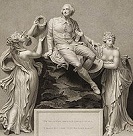
In 1788 London-born English sculptor Thomas Banks (1735-1805) sculpted Shakespeare Attended by Painting and Poetry after being commissioned by John Boydell for 500 guineas for his new Shakespeare Gallery in Pall Mall, which opened in May 1789; the pedestal reads: "He was a Man, take him for all in all, I shall not look upon his like again"; moved in 1871 to the garden in Shakespeare's home of New Place, Stratford-upon-Avon.
In 1788-1820 after King (1760-1820) George III (1738-1820) began suffering from bouts of insanity, Shakespeare's "King Lear" was banned from the British stage; he died deaf blind and mad like you know who.
In 1794 the grave of William Shakespeare in Holy Trinity Church in Stratford-upon-Avon, England is looted?; first pub. in The Argosy mag. in 1879.
In 1795 English Shakespeare forger William Henry "Samuel" Ireland (AKA Vortigern) (1775-1835) had Newly Discovered Documents by William Shakespeare pub. by his daddy Samuel Ireland (1744-1800); too bad, they're soon exposed as forgeries, causing the supposedly new Shakespeare play "Vortigern and Rowena" to flop next Apr. 2, after which he comes clean in Authentic Account (1796), causing his daddy to be accused of being in with it, causing him to pub. A Vindication of His Conduct in Nov. 1796.
In 1802 John Boydell (1719-1804) pub. an ed. of Shakespeare illustrated by the best artists in England, and launches a movement to reform publishing; now artists have more to paint than portraits of rich patrons.
On May 10, 1817 English Romantic poet John Keats (1795-1821) wrote a letter to Benjamin Robert Haydon telling about how he keeps a bust of Shakespeare beside him while writing, with the soundbyte: "I remember your saying that you had notions of a good Genius presiding over you. I have of late had the same thought - for things which I do half at Random are afterwards confirmed by my judgment in a dozen features of Propriety. Is it too daring to fancy Shakespeare this Presider?"
In 1818 English prude Thomas Bowdler (1754-1825) pub. The Family Shakespeare, which censors (bowdlerizes) all the sexual material and blasphemies by expurgation and paraphrase.
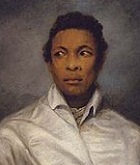
In 1825 after emigrating to England to escape discrimination, New York City-born African-Am. stage actor Ira Aldridge (1807-67) debuted at the Royal Coburg Theatre in London as Oroonoko in the Thomas Southerne adaptation of the Aphra Behn play, going on to play the title role in Shakespeare's "Othello", and tour Europe in 1852, becoming one of 33 English stage actors honored with a bronze plaque at the Shakespeare Memorial Theatre in Stratford-upon-Avon.
In 1835 French visitor and Am. groupie Alexis Charles Henri Clerel (Clérel) de Tocqueville (1805-59) pub. Democracy in America, Vol. 1, which contains the soundbyte: "There is hardly a pioneer hut that does not contain a few odd volumes of Shakespeare."
In 1838 English comedic actor Henry Compton (1805-77) joins the co. at the Theatre Royal in Drury Lane, London, going on to become the #1 Shakespearean clown of Victorian England, especially known for playing Touchstone in "As You Like It".
In 1843 German Romantic composer Felix Mendelssohn (Jakob Ludwig Felix Mendelssohn Bartholdy) (1809-47) debuted Incidental Music to Shakespeare's "A Midsummer Night's Dream", Op. 61 in Potsdam, which contains the ever-popular Wedding March.
On Mar. 14, 1847 Italian composer Giuseppe Fortunino Francesco Verdi (1813-1901) debuted his opera Macbeth in Florence, becoming a hit and leading to Otello On Feb. 5, 1887 in Milan, and Falstaff on Feb. 9, 1893 in Milan, the last of his 28 operas; leaves an unfinished King Lear, with libretto by Antonio Somma, which he offers to composer Pietro Mascagni, with the soundbyte: "The scene in which King Lear finds himself on the heath scared me."
On Sept. 27, 1847 the (Old) Broadway Theatre at 326-330 Broadway and 98 Anthony (Worth) Street in Manhattan, N.Y. (cap. 4.5K) opened, modeled on the Haymarket Theatre in London, becoming the largest theater so far in New York City, closing on Apr. 2, 1859 with a production of Shakespeare's "Antony and Cleopatra".

In 1848-55 the Calif. Gold Rush made instant millionaires out of some miners, who actually were Shakespeare literate, demanding performances and correcting wrong lines, throwing buckskin purses full of gold to show appreciation. A favorite performer was McKean Buchanan (1823-72), who once performed on the stump of a giant redwood tree called the Discovery Tree (Big Stump) in Calaveras Grove.
We were a wrong fit right from the start? On May 10, 1849 the Astor Opera House Riot in Manhattan, New York City that kills 25 and injures 120+ results from a jealousy feud between stage actors Edwin Forrest (1806-72) of the U.S. and William Charles Macready (1793-1873) of England, caused when Forrest hissed him from the audience in 1843 in Edinburgh after an English audience hissed him in Macbeth, and this time Macready plays Macbeth, the riot causing the militia to be called out; after barely escaping with his life, Macready was forced to leave the U.S., and retired from the stage in 1851; in 1852 Forrest's wife Catherine divorced the ham in a sensational divorce trial, which only boosts his career?
In 1850 the Winter Garden Theatre (originally Tripler's Hall) in New York City at 667 Broadway opened as a venue for Swedish Nightingale Jenny Lind; too bad, when she arrived it wasn't finished, causing her to appear at Castle Garden instead; in Dec. 1850 thousands of Freemasons meet there; in Feb. 1842 a memorial service for novelist James Fenimore cooper was held there, presided over by Daniel Webster, with eulogies by Washington Irving and William Cullen Bryant; in 1854 it was rebuilt as the New York Theatre; on May 15, 1855 it was renamed Metropolitan Hall, followed on Dec. 27, 1855 by Laura Keene's Varieties; too bad, the Panic of 1857 caused it to close; in 1859 it was remodeled by Dublin, Ireland-born impresario Dion Boucicault (Dionysius Lardner Boursiquot) (1820-90), who renamed it Winter Garden Theatre; on Nov. 25, 1864 Junius Brutus Booth, Junius Brutus Booth Jr., Edwin Booth, and John Wilkes Booth staged a benefit performance of Shakespeare's "Julius Caesar" to raise funds for a statue of Shakespeare in Central Park, after which on Apr. 14 (Good Fri.), 1865 John Wilkes Booth asassinates Lincoln at Ford's Theatre in Washington, D.C. while viewing a performance of "Our American Cousin", crying out the words of Brutus "Sic semper tyrannis".

In 1851 English astronomer William Lassell (1799-1880) discovered Uranus' moons Ariel and Umbriel, starting the tradition of naming Solar System moons after Shakespeare's characters, causing Queen Victoria to ask to meet him when she visits Liverpool, after which he builds a 48-in. telescope in Malta to discover glorious new make-benefit moons for the Queen; no astral body is named after Shakespeare himself until ?
In 1857 American writer Delia Salter Bacon (1811-59) started the ball rolling by pub. The Philosophy of the Plays of Shakspere Unfolded, the first comprehensive theory that Shakespeare wasn't the real author of the plays, which claimed that the Shakespeare plays were written by a group incl. the usual suspects Sir Francis Bacon, Sir Walter Raleigh, Edmund Spenser, the 17th Earl of Oxford, and Thomas Sackville, 1st Earl of Dorset and Baron Buckhurst (1536-1608), who in 1561 co-wrote the play Gorboduc or Ferrex and Porrex, the first English drama written in blank verse, which was performed for Elizabeth I on Jan. 18, 1562.
In 1862 Lambeth, London-born Sir Arthur Seymour Sullivan (1842-1900) composes Incidental Music to Shakespeare's "The Tempest" as his graduation piece from the Leipzig Conservatoire in Germany, becoming a hit, launching his composing career.
On Apr. 14, 1865 (Good Friday) Shakespeare-lover Pres. Abraham Lincoln (b. 1809) is assassinated by "the youngest tragedian in the world", famous Shakespearean actor John Wilkes Booth (1838-65) in Ford's Theater in Washington D.C. while watching a performance of Tom Taylor's 1858 Our American Cousin, find out on the next all-new episode of The Soul Man.
On Feb. 3, 1869 the spectacular modern Booth's Theatre at the corner of 23rd St. and Sixth Ave. in Manhattan, N.Y. opens, built by Bel Air, Md.-born Shakespearean actor Edwin Thomas Booth (1833-93) (brother of Lincoln assassin John Wilkes Booth), featuring a large statue of his Shakeseparean actor father Junius Brutus Booth by sculptor Thomas Ridgeway Gould, and the fist stage lights that can be completely extinguished during a performance; too bad, the public's taste is too low for Shakespeare, and it goes bankrupt, and is sold in Dec. 1881, becoming McCreery & Co. Dept. Store (until 1965).
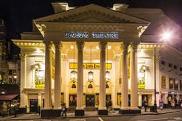
On Nov. 25, 1871 after seeing Samuel Phelps play Hamlet as a teenie, turning him onto a stage career, Somerset-born English actor Sir Henry Irving (John Henry Brodribb) (1838-1905) debuted in the ailing 2.1K-seat Lyceum Theatre (founded 1765) in Westminster, London as Mathias in "The Bells", based on Leopold Lewis' "Le Juif Polonais", which runs for 150 nights, making him an instant star and turning the theater around; in 1874 he stars in Shakespeare's "Hamlet", which runs for 200 nights, followed by Macbeth in 1875, Othello in 1876, and Richard III in 1877. In 1878 he takes over as mgr. and partners with Alice Ellen Terry (1847-1928) (great-aunt of Sir John Gielgud), playing Hamlet to her Ophelia in "Hamlet", followed by Shylock to her Portia in "The Merchant of Venice" in 1879, becoming the first to give Jewish merchant Shylock a dignified treatment, followed by "Othello" (1880), "Romeo and Juliet" (1881), "Much Ado About Nothing" (1882), "Twelfth Night" (1884), "Macbeth" (1884) (w/music by Arthur Sullivan), "Henry VIII" (1892), "King Lear" (1892), "Cymbeline" (1896), and "Coriolanus" (1902); they go on to become the #1 Shakespearean actor and actress in Britain, touring Britain, Canada, and the U.S. In 1895 he becomes the first British actor to receive a knighthood. On Oct. 13, 1905 he dies after playing Becket and uttering his dying words "Into thy hands, O Lord, into thy hands", the chair he was sitting in placed in the Garrick Club; he is cremated and buried in Westminster Abbey; his statue is erected near the Nat. Portrait Gallery in London. In 1906 his personal asst. and theater mgr. Bram Stoker pub. his bio., and is thought to have based his char. of Dracula on him. In 1925 Terry is created dame, becoming the 2nd performer after Genevieve Ward.

In 1875 Irish lit. critic Edward Dowden (1843-1913) pub. Shakespeare: A Critical Study of His Mind and Art, which introduces the Arc of Shakespeare's Life, starting with the happy comedies in the 1590s, the dark night of the soul and great tragedies in the early 1600s, and the serene last romances at the end of his career.
In 1882 after graduating from Oxford U., Francis Robert "Frank" "F.R." Benson (1858-1939) makes his debut as Paris in Shakespeare's "Romeo and Juliet" in the Lyceum Theatre in London; in 1883 he founds his own co., which produces all but three of Shakespeare's plays, getting him knighted by George V in 1916.
In 1885 English actor Sir Johnston Forbes-Robertson (1853-1937) makes his New York City debut as Orlando in Shakespeare's "As You Like It", going on to become one of the greatest Hamlets of all time, despite hating his job.
In 1887 U.S. Rep. (R-Minn.) (1863-9) Ignatius Loyola Donnelly (1831-1901) pub. The Shakespeare Myth, followed in 1888 by The Great Cryptogram, Francis Bacon's Cipher in the So-Called Shakespeare Plays, the original Da Vinci Code, claiming that internal codes prove that Sir Francis Bacon is the real Shakespeare. Too bad, in 1882 he also pub. "Atlantis: The Antediluvian World", tainting his Shakespeare theories with the mythical lost continent of Atlantis.

In 1888 the bronze-stone Shakespeare Memorial by gay Scottish sculptor Lord Ronald Charles Gower (Sutherland-Leveson-Gower) (1845-1916) was unveiled behind the Swan Theatre in Stratford-upon-Avon, England; it incl. corner statues of Hamlet, Prince Hal, Falstaff, and Lady Macbeth; later moved in front of the Royal Shakespeare Theatre; French actress "The Divine" Sarah Bernhardt (1844-1923) modeled for Lady Macbeth in his Montparnasse, Paris studio.
In 1890 the European starling was introduced into the U.S. (Central Park in New York City) from Europe by Eugene Schieffelin (1827-1906) as part of his project to introduce all birds mentioned in Shakespeare's works (in this case Henry IV Pt. I, Act 1, Scene I), and spread out of control, destroying fruit and vegetable crops; on Oct. 4 Eastern Air Lines Flight 375 (Lockheed L-188) crashes on takeoff from Boston Airport in Mass. after it runs into a flock of 10K starlings, killing 62 of 72 aboard - Shakespeare killed them? In 1899 English writer Samuel Butler (1835-1902) of "Erewhon" fame pub. Shakespeare's Sonnets Reconsidered, which claimed that they are really about a homosexual affair.
In 1896 Irish jealous, er, playwright George Bernard Shaw (1895-1950) pub. the article Blaming the Bard in Saturday Review, dissing Shakespeare, with the soundbyte: "This immortal pilferer of other men's stories and ideas, with his monstrous rhetorical fustian, his unbearable platitudes, his pretentious reduction of the subtlest problems of life to commonplaces against which a Polytechnic debating club would revolt, his incredible unsuggestiveness, his sententious combination of ready reflection with complete intellectual sterility, and his consequent incapacity for getting out of the depth of even the most ignorant audience, except when he solemnly says something so transcendentally platitudinous that his more humble-minded hearers cannot bring themselves to believe that so great a man really meant to talk like their grandmothers." In 1901 he pub. Three Plays for Puritans, which incl. a preface coining the term "Bardolatry".

On Nov. 4, 1899 Austrian neurologist Sigmund Freud (1856-1939) pub. The Interpretation of Dreams (Die Traumdeutung), claiming that he's discovered hidden layers of primitive sexual and aggressive forces that must be controlled to prevent societies from collapsing into chaos and destruction, founding Psychoanalysis, which focuses on the all-powerful Oedipus (Oedipal) Complex, which he claims Shakespeare's Hamlet suffers from; he gets a whopping $200 for it - not enough porno in it to pay more? In 1910 English psychoanalyst (protege of Sigmund Freud) Alfred Ernest Jones (1879-1958) pub. the article "The Oedipus-Complex as An Explanation of Hamlet's Mystery: A Study in Motive", which claims that Hamlet suffered from a you know what, influencing Sir Laurence Olivier in his 1948 film; in 1949 he expands it into the book Hamlet and Oedipus.


In 1899 Thomas Edison-trained film pioneer William Kennedy Laurie Dickson (1860-1935) (inventor of 35mm celluloid film and the flip-card Mutoscope for peep shows) and Walter Pfeffer Dando debuted King John, the first film adaptation of a Shakespeare play, produced by the British Mutoscope and Biograph Co.; view it.
By the 20th cent. the controversies were kaput, and Shakespeare became an institution, the answer to my question is 1.2 million wills.
In 1901 after failing to get a match with Sir Francis Bacon, self-taught Ohio State U. physicist Thomas Corwin Mendenhall (1841-1924), pioneer of stylometry measures word-length frequency in the works of William Shakespeare and finds that it is very close that of Christopher Marlowe, with the soundbyte: "In the characteristic curve of his plays Christopher Marlowe agrees with Shakespeare about as well as Shakespeare agrees with himself."
In 1903 West Ilsley, Berkshire-born English Shakespearean scholar Sir Edmund Kerchever Chambers (1866-1954) pub. The Mediaevel Stage (2 vols.), followed by The Elizabethan Stage (4 vols.) (1923), ("one of those books which perhaps no living person is in a position to criticise adequately" - W.W. Greg), Shakespeare: A Survey (1925), William Shakespeare: A Study of Facts and Problems (2 vols.) (1930), and Shakespearean Gleanings (1941).
In 1904 English lit. scholar Andrew Cecil Bradley (1851-1935) pub. Shakespearean Tragedy, which made him #1 among Shakespearean scholars, treating the chars. like they're real people, becoming a std. work, essential for passing exams in English schools, causing the rhyme to circulate: "I dreamt last night that Shakespeare's ghost/ Sat for a civil service post./ The English paper for that year/ had several questions on King Lear/ Which Shakespeare answered very badly/ Because he hadn't read his Bradley"; too bad, by the 1950s he was discredited for his Victorian views, esp. after the 1933 satirical essay "How Many Children Had Lady Macbeth?" by English lit. critic Lionel Charles Knights (1906-97).
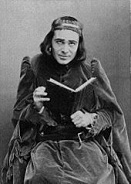
On Aug. 30, 1907 German-born Anglo-Am. "Dr. Jekyll/Mr. Hyde" actor Richard Mansfield (b. 1857) dies in New London, Conn. of liver cancer after being accused of being Jack the Ripper; "As an interpreter of Shakespeare, he had no living equal in his later days, as witnessed by the princely grace, the tragic force of his Richard, his thrilling acting in the tent scene of 'Caesar', the soldierly dignity and eloquence of his Prince Hal, and the pathos of the prayer in that play. He was the greatest actor of his hour, and one of the greatest of all times." (NYT)

On Apr. 19, 1908 Macbeth debuted, produced by English-born Am. film pioneer James Stuart Blackton (1875-1941), becoming the first known film version.
On Nov. 3, 1908 J. Stuart Blackton's and Charles Kent's Antony and Cleopatra debuted, becoming the first known film version, starring Florence Lawrence and Betty Kent as Cleopatra, William V. Ranous and William Phillips as Octavian, and Charles Chapman as Mark Antony.
On Sept. 6, 1909 the Comedy Theatre at 110 West 41st St. in Manhattan, N.Y. (cap. 687) opens with The Melting Pot, becoming the place where Katharine Cornell and Ruth Draper make their debuts; in 1927 Eugene O'Neill's In the Zone debuted, becoming his first Broadway play; in 1937 it reopens as the Mercury Theatre, debuting Orson Well's adaptation of Shakespeare's "Julius Caesar", in which he plays Brutus; on Oct. 31, 1938 reporters hound Welles during an all-night rehearsal of Georg Buechner's Danton's Death the day after his infamous The War of the Worlds radio broadcast there; in 1939 it switches to classic Yiddish theater; in 1942 it is demolished.

On Dec. 25, 1909 Charles Kent's and J. Stuart Blackton's A Midsummer Night's Dream (Vitagraph Studios) debuted, starring William V. Ranous as Bottom, Walter Ackerman as Demetrius, Maurice Costello as Lysander, Rose Tapley as Hermia, and Gladys Hulette as Puck.

On Feb. 5, 1910 Eugene Mullin's and Charles Kent's Twelfth Night debuted, produced by the Vitagraph Co. of Am. based on the Shakespeare play, starring Julia Swayne Gordon as Olivia, Florence Turner as Viola, Edith Storey as Sebastian, Tefft Johnson as Orsino, and Charles Kent as Malvolio.
In 1910 after being converted by reading Ignatius Donnelly's "The Great Cryptogram", British MP (1895-1906) Sir Edward Durning-Lawrence (1837-1914) pub. Bacon is Shake-Speare; "England is now declining any longer to dishonour and defame the greatest Genius of all time by continuing to identify him with the mean, drunken, ignorant, and absolutely unlettered, rustic of Stratford who never in his life wrote so much as his own name and in all probability was totally unable to read one single line of print." He follows with The Shakespeare Myth (1912), Macbeth Proves Bacon is Shakespeare (1913), and Key to Milton's Epitaph on Shakespeare (1914).
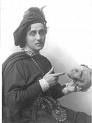
In 1910 English-born Am. stage actress Julia Marlowe (1866-1950) began appearing with her Am. hubby Edward Hugh Sothern (1859-1933) in a series of Shakespeare plays (until 1914), becoming known as a top Shakespearean duo.
In Feb. 1911 Gerolamo Lo Savio's Il Mercante di Venezia (The Merchant of Venice) debuted, based on the Shakespeare play.
On Apr. 22, 1911 South African-born English Shakespearean actor Basil Rathbone (1892-1967) made his stage debut at the Theatre Royal in Ipswich as Hortenso in Shakespeare's "The Taming of the Shrew", followed by New York City next year, and London in 1914, his favorite role being Romeo; his film career doesn't begin until 1925.

On Nov. 28, 1911 The Tempest debuted, based on the Shakespeare play, dir. by Edwin Thanhouser (1865-1956), starring Ed Genung as Ferdinand, and Florence La Badie (1888-1917) as Miranda.
In 1911 William George Barker's and Sir Herbert Beerbohm Tree's Henry VIII, produced by Barker Motion Photography Co. based on the Shakespeare play stars Arthur Bourchier as Henry VIII, Violet Vanbrugh as Catherine of Aragon, Laura Cowie as Anne Boleyn, and Sir Herbert Beerbohm Tree as Cardinal Wolsey, and features a coronation scene with music written by English composer Sir Edward German (German Edward Jones) (1862-1936), who becomes the first composer to write music for a British film.
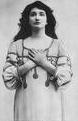
In 1912 English actor Harley Granville-Barker (1877-1946) became mgr. of the Savoy Theatre (until 1914), along with his wife Lillah McCarthy (1875-1960), going on to produce several Shakespeare plays, innovating to capture the spirit.
On Mar. 28, 1913 Lucius J. Henderson's Cymbeline, produced by Thanhouser Film Corp. debuted, becoming the first movie adaptation of the Shakespeare play, starring William Russell as Cymbeline, Jean Darnell as his queen, Lorence La Badie as Imogen, James Cruze as Leonatus, and William Garwood as Iachimo.
In 1914 Lois Weber's The Merchant of Venice, based on the Shakespeare play debuted, becoming the first full-length feature film dir. by a woman.
In Nov. 1915 Maurice Elvey's Love in a Wood debuted, based on Shakespeare's "As You Like It", starring Gerald Ames as Orlando, Elisabeth Risdon as Rosalind, Kenelm Foss as Oliver, and Vera Cunningham as Celia.


In 1916 Walter West's The Merchant of Venice debuted, based on the Shakespeare play, produced by Broadwest, starring Matheson Alexander Lang (1879-1948) (screen debut) as Shylock, and his wife Nelly Hutin Britton (1876-1965) as Portia, launching Lang's movie career in Britain.
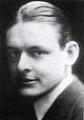
In 1920 T.S. Eliot (1888-1965) pub. The Sacred Wood: Essays on Poetry and Criticism, which "Hamlet and His Problems", with the soundbyte: "These minds often find in Hamlet a vicarious existence for their own artistic realization. Such a mind had Goethe, who made of Hamlet a Werther; and such had Coleridge, who made of Hamlet a Coleridge; and probably neither of these men in writing about Hamlet remembered that his first business was to study a work of art."
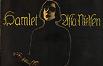
In 1921 Svend Gade's and Heinz Schall's Hamlet debuted, based on "The Mystery of Hamlet" by Edward P. Vining, based on the Shakespeare play with Hamlet becoming a female disguised as a male, starring Danish actress Asta Nielsen.
In Feb. 1922 Dimitri Buchowetzki's Othello debuted, based on the Shakespeare play, becoming the first major film production; stars Emil Jannings as Othello, Werner Krauss as Iago, and Ica von Lenkeffy as Desdemona.
On Apr. 24, 1924 London-born British bestselling novelist Marie Corelli (b. 1855) dies in Stratford-upon-Avon after becoming known for boating on the Avon River in a gondola complete with gondolier brought in from Venice; her house called Mason Croft becomes the home of the Shakespeare Inst. (founded 1951).
On Oct. 11, 1928 English novelist "Who's Afraid of" Virginia Woolf (1882-1941) pub. Orlando: A Biography, about a man born in the reign of Elizabeth I who decides to never grow old and changes into a woman; based on the life of lezzie lovers Vita Sackville-West (1892-1962) (as Orlando) and Violet Trefusis (1894-1972) (as Slavic princess Sasha); gets around censorship by having a woman sprout a you know what before going to bed with another woman?; after Vita left Violet in 1923, Violet hooked up with Singer sewing machine heiress and musical patron Winnaretta Singer (1865-1943) until 1933; it's really about William Shakespeare, who makes a cameo appearance, to be read along with the passage about his sister Judith in "A Room of One's Own" (1929)?
On Oct. 26, 1929 Sam Taylor's The Taming of the Shrew debuted, based on the Shakespeare play, starring Mary Pickford as Katherine, and her hubby Douglas Fairbanks as Petruchio.
On Apr. 23, 1930 the Folger Shakespeare Library, founded by Standard Oil Co. chmn. Henry Clay Folger (1857-1930) opened in Washington, D.C. at 201 E. Capitol St. S.E.; Folger died on June 11. On Apr. 23, 1932 the Shakespeare Memorial Theatre opened in Stratford-upon-Avon, England on guess who's birthday.
In 1934 Southsea, Hampshire-born English historian Dame Frances Amelia Yates (1899-1981) pub. John Florio: The Life of an Italian in Shakespeare's England, followed by A Study of Love's Labour's Lost (1936), exploring whether Holofernes was really Italian brain man John Florio (1553-1625). In 1941 she joins the Warburg Inst. She follows with The French Academies of the Sixteenth Century (1947), The Valois Tapestries (1959), and Giordano Bruno and the Hermetic Tradition (1964), which becomes a big hit with Renaissance historians, revealing the survival of hermeticism, mysticism, magic, and Gnosticism; claims that Bruno was burned at the stake in 1600 for his hermeticism rather than for heliocentrism. She follows with The Art of Memory (1966), about how the ancients did it sans printing and computers, from Simonides of Ceos to Giordano Bruno's Memory Wheel (1582), ending with Gottfried Leibniz and the emergence of the scientific method in the 17th cent. She follows with Theatre of the World (1969), which claims that the Globe Theatre was Vitruvian in architectural design and symbolism, The Rosicrucian Enlightenment (1972), Astraea: The Imperial Theme in the Sixteenth Century (1975), Shakespeare's Last Plays: A New Approach (1975), The Occult Philosophy in the Elizabethan Age (1979), Lull and Bruno: Collected Essays, Vol. 1 (1982) (posth.), Renaissance and Reform: The Italian Contribution: Collected Essays, Vol. 2 (1983) (posth.), and Ideas and Ideals in the North European Renaissance: Collected Essays, Vol. 3 (1984) (posth.).
On Oct. 30, 1935 Max Reinhardt's and William Dieterle's A Midsummer's Night Dream debuted, based on the Shakespeare play, starring Olivia de Havilland as Hermia, miscast Dick Powell as Lysander, Ian Hunter as Theseus, Verree Teasdale as Hippolyta, James Cagney as Bottom, Joe E. Brown as Flute, Victor Jory as Oberon, Anita Louise as Titania, and Mickey Rooney as Puck; musical score by Felix Mendelssohn, re-orchestrated by Erich Wolfgang Korngold; Rooney breaks his leg skiing during filming, pissing-off Jack Warner, who threatens to kill him then break his other leg; despite a record 2,971 theater cancellations it does $1.23M box office on a $981K budget.
On Aug. 20, 1936 George Cukor's Romeo and Juliet debuted, based on the William Shakespeare play, starring Leslie Howard as Romeo Montague, Norma Shearer as Juliet Capulet, John Barrymore as Mercutio, Basil Rathbone as Tybalt, and Edna May Oliver as Juliet's nurse; too bad, on the night of the debut, MGM producer Irving Thalberg (Shearer's hubby) dies, causing publicist Frank Whitbeck to forget to interview the actors and only announce their arrivals; after the actors chosen are all too old for their parts, and the public stays away from "artsy" movies, it loses $922K on a $2.075M budget, souring Hollywood to Shakespeare flicks for a decade; "It's one picture that if I had to do over again, I'd know how. I'd get the garlic and the Mediterranean into it." (Cukor)
On Sept. 3, 1936 Paul Czinner's As You Like It debuted, based on the Shakespeare play (first to made into a talkie), becoming the first screen performance of Shakespeare by Laurence Kerr "Larry" Olivier (1907-89) as Orlando, along with Czinner's wife Elisabeth Bergner as Rosalind, Leon Quartermaine (final film performance) as Jacques, and Henry Ainley (final film performance) as Duke Senior; scored by William Walton, who goes on to score Olivier's "Henry V", "Hamlet", and "Richard III"; gay buds Sinner, er, Czinner and Olivier hook up offscreen?
On Aug. 9, 1940 A. Edward Sutherland's The Boys of Syracuse debuted, based on Shakespeare's "The Comedy of Errors", starring Allan Jones as Antipholus, Joe Penner as Dromio, Irene Hervey as Adriana, Rosemary Lane as Phyllis, and Martha Raye as Luce; the 1938 musical by Richard Rodgers and Lorenz Hart, with libretto by George Abbott was the first musical based on a Shakespeare play; incl. the songs Falling in Love with Love, This Can't Be Love, Sing for Your Supper.
On Nov. 22, 1944 Laurence Olivier's Henry V debuted, based on the Shakespeare play, starring Olivier as Henry V, Renee Asherson as Princess Katherine, Leslie Banks as the Chorus (after Robert Donat unsuccessfully lobbies for the role), and Felix Aylmer as the Archbishop of Canterbury, taking actor-dir. Laurence Kerr "Larry" Olivier (1907-89) to the #1 slot among actors with a cool score by composer Sir William Walton, becoming the first Shakespeare play that is both artistically and commercially successful; "Dedicated to the Commandos and Airborne Troops of Great Britain the spirit of whose ancestors it has been humbly attempted to recapture."
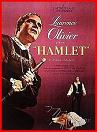
On May 4, 1948 Laurence Olivier's Hamlet, based on the Shakespeare play (first sound version in English) debuted, starring Olivier as Hamlet, Felix Aylmer as Polonius, Norman Wooland as Horatio, and Basil Sydney as King Claudius; too bad, half of the dialogue is cut; makes a star of English actress Jean Simmons (1929-) (Ophelia), who moves to Hollywood in 1950 after marrying Stewart Granger, after which she gets bigger roles than him, causing them to divorce in 1960, after which neither get big roles?; does $3.2M box office on a £500K budget.
On Oct. 1, 1948 Orson Welles' Macbeth debuted, based on Shakespeare's play, starring Welles as Macbeth, Jeannette Nolan (film debut) as Lady Macbeth, Dan O'Herlihy as Macduff, Roddy McDowall as Malcolm, and Edgar Barrier as Banquo; after Welles can't get Republic Pictures to cough up enough money, he shoots it only 23 days, and it is panned by audiences for the cheap sets and cheap Scottish accents, causing Welles to take a 10-year break from Hollyweird; in 1950 a new version is released sans accents, finally earning a small profit on its $800K budget.
On Dec. 30, 1948 Cole Porter (1891-1964), Samuel Spewack (1899-1971), and Bella Spewack (1899-1990) debuted their musical Kiss Me, Kate at the New Century Theatre in New York (1,077 perf.), becoming Porter's biggest hit; stars Alfred Drake, Patricia Morison, Lisa Kirk, and Harold Lang; based on Shakespeare's "The Taming of the Shrew", and inspired by the backstage bickering of Alfred Lunt and Lynn Fontanne during a Shakespeare play; choreography by German immigrant Hanya Holm (1893-1992), who goes on to choreograph "My Fair Lady" in 1956 and "Camelot" in 1960; filmed in 1953 starring Howard Keel, Kathryn Grayson, and Ann Miller; features the songs So In Love, Brush Up Your Shakespeare, Kiss Me, Kate, Another Op'nin' Another Show, We Open in Venice, Tom, Dick or Harry, I've Come to Wive It Wealthily in Padua, Too Darn Hot, Always True to You in My Fashion.

In Mar. 1950 David Bradley's Julius Caesar debuted, based on the Shakespeare's play, the first film version with sound, using Northwestern U. students as extras stars up-and-coming Charlton Heston as Mark Antony (only paid cast member), Bradley as Brutus, and Harold Tasker as Caesar.
In 1951 the Shakespeare Inst. is founded at Mason Croft in Statford-upon-Avon, England, home of British novelist Marie Corelli, moving in the 1970s to the U. of Birmingham, becoming the first center for postgraduate study of William Shakespeare and the lit. of the English Renaissance; in the 1980s it moves back to Mason Croft, and in 1996 it opens the Shakespare Inst. Library.
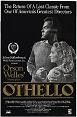
On May 10, 1952 Orson Welles' Othello (B&W) debuted, based on the Shakespeare play, shot in Morocco, Venice, Tuscany, and Rome, starring Welles as Othello, Michael MacLiammoir as Iago, and Suzanne Cloutier as Desdemona, becoming a hit in Europe but not the U.S.; in 1992 it was restored and re-released.
On June 4, 1953 Joseph L. Mankiewicz's Julius Caesar debuted, based on the Shakespeare play with musical score by Mikos Rozsa and an all-star cast stars Marlon Brando as Mark Antony, James Mason as Brutus, John Gielgud as Cassius, Louis Calhern as Caesar, Edmond O'Brien as Casca, Greer Garson as Calpurnia, and Deborah Kerr as Portia.
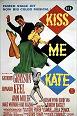
On Nov. 26, 1953 George Sidney's Kiss Me Kate debuted, a 3-D MGM adaptation of the Broadway musical based on Shakespeare's "The Taming of the Shrew", with songs by Cole Porter, starring ex-marrieds Fred Graham (Howard Keel) and Lili Vanessi (Kathryn Grayson) playing Petruchio and Kate, with Ann Miller as Lois Lane playing Bianca; does $3.1M box office on a $1.98M budget; incl. songs Where is the Life That Late I Led, Brush Up Your Shakespeare, Too Darn Hot.
In 1953 the New York Shakespeare Festival was founded by Brooklyn-born Jewish impresario Joseph Papp (1921-91), with annual summer stagings in the outdoor Delcorte Theater in Central Park starting in 1962. Also in 1953 the Stratford (Shakespearean) Festival in Ontario, Canada was founded by journalist Harry Thomas "Tom" Patterson (1920-2005), going on to become the largest repertory theater in North Am.; on July 13, 1953 "Richard III" opened, starring Alec Guinness, and dir. by Sir Tyrone Guthrie (1900-71). In 1957 the Colo. Shakespeare Festival in Boulder was founded, becoming the 2nd Shakespeare festival in the U.S.
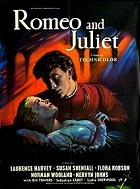
On Sept. 1, 1954 Renato Castellani's Romeo and Juliet (Rank Org.) debuted, based on the Shakespeare play, starring Laurence Harvey as Romeo, Susan Shentall (after Joan Collins passes and she is picked out in a bar, getting married and never acting again) as Juliet, Flora Robson as the Nurse, Mervyn Johns as Friar Laurence, Bill Travers as Benvolio, Sebastian Cabot as Lord Capulet, Enzo Fiermonte as Tybalt, and John Gielgud as the Chorus; watch movie.
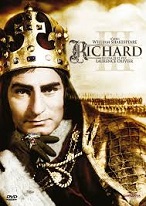
On Dec. 13, 1955 Laurence Olivier's Richard III (London Films) debuted, based on the Shakespeare play, starring Olivier as humpbacked twisted Richard of Gloucester (1452-85) in an acclaimed performance; Cedrick Hardwicke plays his brother Edward IV (1442-83), and John Gielgud plays doomed Duke George of Clarence (1449-78) of drowned-in-a-butt-of-malmsey fame; Salvador Dali paints Olivier's portrait in costume during filming; Olivier models his raven-hared looks on widely-hated theatrical producer Jed Harris (1900-79), who was later used by Disney as the basis for the Big Bad Wolf in "Three Little Pigs"; does £400K U.K. and $2.6M U.S. box office on a £6M budget; Elizabeth II and Prince Philip attended the debut at Leicester Square Theatre; after being shown on U.S. network TV on Mar. 11, 1956 (Sun.) simultaneous with its cinema release, it tanked at the box office, but after being re-released in 1966 it broke box office records, ending up doing more to popularize Shakespeare than any other single work?
On Mar. 15, 1956 Fred M. Wilcox's Forbidden Planet debuted, based on Shakespeare's "The Tempest" set in the year 2200 C.E. on Altair-4, starring Walter Pidgeon as Krell-haunted Dr. Edward Morbius, Anne Francis as his tempting virginal daughter Altaira, Leslie Nielsen as mister lucky Cmdr. John J. Adams, and Robby the Robot as himself; it is later looted blind by Gene Roddenberry for his "Star Trek" series, who also steals the pure-white Daniel Boone (Fess Parker) and brilliant educated halfbreed sidekick Mingo (Ed Ames) for his Capt. Kirk and Spock?
On Jan. 15, 1957 Akira Kurosawa's Throne of Blood (Kumonosu-jo) (Cobweb Castle) debuted, based on Shakespeare's "Macbeth" and set in feudal Japan, starring Toshiro Mifune as Macbeth, Isuzu Yamada as Lady Macbeth, and Minoru Chiaki as Banquo.
On Sept. 26, 1957 Leonard Bernstein (1918-90), Stephen Sondheim (1930-), and Arthur Laurents (1917-2011) debuted their musical West Side Story at the Winter Garden Theatre in New York (732 perf.); based on Shakespeare's "Romeo and Juliet", about the Jets (white) and the Sharks (Puerto Rican) in ethnic blue-collar Upper West Side, New York City; Tony of the Jets (Larry Kert), best friend of gang leader Riff (Michael Callan) falls in love with Maria (Carol Lawrence), sister of Bernardo, leader of the Sharks; produced by Harold Prince and Robert E. Griffith; choreographed by Jerome Robbins; filmed in 1961; features the songs Maria, America, Tonight, One Hand, One Heart, Officer Krupke. Somewhere, Tonight, A Boy Like That, I Feel Pretty, Cool.
On Mar. 20, 1961 the Royal Shakespeare Co. in Stratford-upon-Avon, Warwickshire, England was officially established, with the old Shakespeare Memorial Theatre renamed the Royal Shakespeare Theatre.
On Oct. 18, 1961 Robert Wise's and Jerome Robbins' West Side Story debuted, a musical based on Shakespeare's "Romeo and Juliet" about the Jets and the Sharks, New York City street gangs who like to break into song and dance, featuring the love story between Maria (Natalie Wood) (voice by Marni Nixon) and Richard Beymer (voice by Jimmy Bryant); also stars Russ Tamblyn, Rita Moreno as Anita, George Chakiris, Simon Oakland, and Ned Glass; the Emeralds lose their turf to the Jets, and the Hawks fail to grab it, leaving the Sharks; does $43.7M box office on a $6M budget; incl. the songs Maria, America, Tonight, One Hand, One Heart, Officer Krupke.
On June 12, 1963 Joseph L. Mankiewicz's Cleopatra debuted, becoming an extravagant $44M, 2-year semi-flop (break-even) (most expensive film to date), based on "The Life and Times of Cleopatra" by C.M. Franzero, not Shakespeare (can't be proven in court); foul-mouthed glam babe Elizabeth Taylor becomes the first female actor to earn $1M for a film; Rex Harrison (first choice: Peter Finch) is the only decent lead actor, attempting to portray Julius Caesar, but coming off as Prof. Henry Higgins in armor?; Harrison's chicken legs are covered with togas and robes; Martin Landau plays Caesar's and Anthony's friend Rufio; Roddy McDowall plays Octavian; Carroll O'Connor plays Casca, the first to stab Caesar in the back; chicken-legged unathletic Richard Burton (who replaces athletic Stephen Boyd when production moves to Italy) bombs as he-man Mark Antony, but starts a torrid public affair with Liz, who dumps Eddie Fisher for him, marrying him nine days after the divorce with Fisher is final in 1964; Cesare Danova plays Cleopatra's head slave Apollodorus; Hume Cronyn plays Cleopatra's minister Sosigenes; six hours of film are created for two separate 3-hour movies (a Caesar movie and an Antony movie), but after 20th Cent. Fox nearly goes bankrupt, new studio head Darryl Zanuck orders it cut down for theaters to four hours, cutting most of the Harrison footage in favor of the celeb love affair of Liz and Burton, pissing off Mankiewicz for life; during filming Taylor becomes seriously ill and needs an emergency tracheotomy, then two weeks later shows up at the Academy Awards sporting a pair of crutches and a visible scar on her throat; production begins in London but moves to Italy when the $5M mark is reached; the scenes in Rome are delayed for weeks because of heavy rains; several Euro heads of state visit the set; no amount of advertising saves it, but it later makes money with TV rights and home versions; does $26M box office on a $44M budget, becoming the first highest-grossing film of the year to run at a loss (until ?); it later makes $57.7M total; "This picture was conceived in a state of emergency, shot in confusion, and wound up in blind panic" (Joseph L. Mankiewicz); "The toughest three pictures I ever made" (ditto); "I only came to see the asp" (Charles Addams).
On Nov. 13, 1963 Andrew V. McLaglen's McLintock! (Batjack Productions) debuted, a Western comedy based on Shakespeare's "The Taming of the Shrew" starring John Wayne as cattle baron George Washington McLintock, Maureen O'Hara as Katherine, and Yvonne De Carlo as Louise Warren; Wayne's son Patrick Wayne plays his son Dev, and Stefanie Powers plays his daughter Becky; brings in $7.25M.
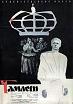
On June 24, 1964 Grigori Kozintsev's Hamlet debuted, based on the Shakespeare play tr. by Boris Pasternak, starring Innokenty Smoktunovsky as Hamlet; features a score by Dmitri Shostakovich.

In 1964 Polish-born Am. lit. critic (former Stalinist) Jan Kott (1914-2001) pub. Shakespeare, Our Contemporary, which reinterprets Shakespeare in light of the 20th cent. "nightmare of history" and his own existential life story, comparing him with Eugene Ionesco and Samuel Beckett, influencing Peter Brook, Charles Marowitz, and Roman Polanski.
In 1964 Ipswich, Suffolk-born Sir Trevor Robert Nunn (1940-) became artistic dir. of the Royal Shakespeare Co. (until 1986), going on to produce a televised version of "Antony and Cleopatra" in 1974, starring his first wife Janet Suzman, and a musical adaptation of "The Comedy of Errors" in 1976, followed by a film version of "Macbeth" (starring Ian McKellen and Judi Dench) in 1976, and "Othello" (starring Ian McKellen and Imogen Stubbs) in 1990; in 1981 he dir. the English version of the musical "Cats", followed by the first English production of "Les Miserables" in 1985; in 1994 he married Imogen Stubbs; in 1996 he dir. a film version of "Twelfth Night"; in 2004 he dir. "Hamlet", starring Ben Whishaw as Hamlet and Imogen Stubbs as Gertrude at the Old Vic Theatre in London; in 2007 he dir. "King Lear", which plays at Stratford-upon-Avon followed by a world tour, starring Ian McKellen, debuting on BBC on Boxing Day, 2008; in 2004 he gave an interview to the Telegraph, in which he utters the soundbyte: "Shakespeare has more wisdom and insight about our lives, about how to live and how not to live, how to forgive and how to understand our fellow creatures, than any religious tract, one hundred times more than the Bible. I’m sorry to say that, but over and over again in the plays there is an understanding of the human condition that doesn't exist in religious books."
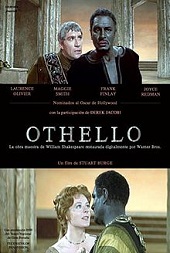
On Dec. 15, 1965 Stuart Burge's Othello (Nat. Theatre of Great Britain) debuted, starring Laurence Olivier (in blackface) as Othello, Maggie Smith as Desdemona, Joyce Redman as Emilia, and Frank Finlay as Iago, featuring the film debuts of Derek Jacobi and Michael Gambon; the first English language version of the play filmed in color and widescreen; Olivier plays his part in high camp, channeling Al Jolson; the first (only?) Shakespeare film in which all the principals are nominated for Oscars; in Oct. 2021 Chinese-Am. U. of Mich. prof. Bright Sheng is attacked by the PC police for showing the film at a seminar.
On Dec. 22, 1966 Orson Welles' Chimes at Midnight debuted, based on Shakespeare's character Sir John Falstaff, starring Welles as Falstaff, Keith Baxter as Prince Hal/Henry V, John Gielgud as Henry IV, Jeanne Moreau as Doll Tearsheet, and Margaret Rutherford as Mistress Quickly; Ralph Richardson is the narrator; the depiction of the 1403 Battle of Shrewbury later inspires "Braveheart" (1995); "If I wanted to get into heaven on the basis of one movie, that's the one I'd offer up" (Welles).

On Feb. 22, 1967 Barbara Garson (1941-) debuted her play MacBird at the Village Gate Theater in New York (386 perf.); a counterculture anti-Vietnam War anti-LBJ pro-third party parody of Shakespeare's "Macbeth", accusing LBJ of murdering JFK, with Lady MacBird uttering the soundbyte "Out, damned odor"; becomes a big hit, sells 500K copies as a book, and is produced worldwide; makes stars of newbies Stacey Keach, William Devane, Cleavon Little, and Rue McClanahan.
On Mar. 3, 1967 Franco Zeffirelli's The Taming of the Shrew debuted, starring Richard Burton and Elizabeth Taylor as feuding Petruchio and Kate, who milk the crowd for tickets while revealing real marital problems offscreen?; does $12M box office on a $4M budget.
On Oct. 8, 1968 Franco Zeffirelli's Romeo and Juliet debuted, starring unknowns Leonard Whiting and Olivia Hussey, and is set in the 1960s, with Laurience Olivier voicing the prologue and epilogue, becoming a hit with teenies; does $38.9M box office on an $850K budget.
On June 4, 1970 Stuart Burge's Julius Caesar debuted, starring Charlton Heston as Mark Antony, Richard Chamberlain as Octavius, Jason Robards as Brutus, John Gielgud as Caesar, Robert Vaughn as Casca, and Diana Rigg as Portia; after Robards' performance is panned, it flops at the box office; "No grander Caesar... No greater cast".
On Feb. 4, 1971 Peter Brook's B&W King Lear debuted, produced by Michael Berkett and Mogens Skot-Hansen and based on the Shakespeare play stars Paul Scofield as Lear, Jack MacGowran as the Fool, Susan Engel as Regan, Irene Worth as Goneril, Anne-Lise Gabold as Cordelia, Patrick Magee as Cornwall, and Tom Fleming as Kent.
On Oct. 13, 1971 Roman Polanski's Macbeth (Playboy Productions) (Columbia Pictures) debuted, based on the Shakespeare play, starring Jon Finch as Macbeth, Francesca Annis as Lady Macbeth, Martin Shaw as Banquo, and Terence Bayler as Macduff; financed by Hugh Hefner, resulting in a nude sleepwalking scene for Lady Macbeth.
In 1979 Trevor Nunn's Macbeth (ITV), debuted, a videotaped version of a Royal Shakespeare Co. production of the Shakespeare play set on a dark stage and dir. by Philip Casson stars Ian McKellen and Judi Dench.
On Aug. 13, 1982 Paul Mazursky's Tempest, based on Shakespeare's "The Tempest" debuted, set in the modern era, starring John Cassavetes as Phillip, Gena Rowlands as Antonia, Susan Sarandon as Aretha, Raul Julia as Kalibanos, and Molly Ringwald (film debut) as Miranda; "Like watching a 10-ton canary as it attempts to become airborne" (Vincent Canby); does $5M box office on a $13M budget.

In 1982 UCB prof. Stephen Jay Greenblatt (1943-) coined the term "New Historicism" in his introduction to "The Power of Forms in the English Renaissance", using Queen Elizabeth's "bitter reaction to the revival of Shakespeare's Richard II on the eve of the Essex rebellion" to illustrate the "mutual permeability of the literary and the historical". In 2004 he pub. Will in the World: How Shakespeare Became Shakespeare; Falstaff is a combo of Shakespeare's father and rival Robert Greene?; Hamlet is a combo of Greene, Shakespeare's son Hamnet, his father, and the "world of damaged residuals" that undercover Roman Catholics had to endure?; Shylock is Jewish physician Roderigo Lopez?
On May 31, 1985 Akira Kurosawa's Ran (Jap. "uprising") debuted, based on Shakespeare's "King Lear", starring Tatsuya Nakadai as aging warlord Hidetora Ichimonji, becoming the most expensive Japanese film produced to date ($12M), winning kudos from critics; musical score by Toru Takemitsu, inspired by Gustav Mahler; does $12M box office in Japan, and $2M-$3M in the U.S.
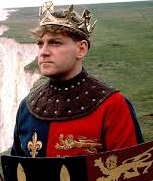
On Oct. 6, 1989 Kenneth Branagh's Henry V debuted, based on the Shakespeare play "Henry V Pt. 1", starring Branagh as Henry V, Robbie Coltrane as Sir John Falstaff, and Emma Thompson as Katharine; does $10M box office on a $9M budget; "The great adventure of a king who defied the odds to prove himself a man."
On Mar. 1, 1990 the FBI recovered a 1611 ed. of Shakespeare's "Hamlet" worth $1M along with five other rare classics that had been stolen from a U. of Penn. library.
On June 23, 1990 Trevor Nunn's Othello debuted on BBC-TV's "Theatre Night", starring Ian McKellen as Othello, Imogen Stubbs as Desdemona, and Willard White as Othello.
On Sept. 5, 1990 Tom Stoppard's Rosencrantz & Guildenstern Are Dead debuted (Stoppard's dir. debut), shot in Yugoslavia based on chars. in Shakespeare's "Hamlet", starring Gary Oldman as Rosencrantz, Tim Roth as Guildenstern, Richard Dreyfuss as the leading player, Iain Glen as Hamlet, and Ian Richardson as Polonius; does a paltry $739K box office.
On Dec. 19, 1990 Franco Zeffirelli's Hamlet debuted, based on the Shakespeare play (first film from Gibson's Icon Productions), starring Gibson as Hamlet, Glenn Close as Queen Gertrude, Stephen Dillane as Horatio, and Helena Bonham Carter as Ophelia; does $20.7M box office.
On Aug. 30, 1991 Peter Greenaway's Prospero's Books debuted, based on Shakespeare's "The Tempest", starring 87-y.-o. John Gielgud as Prospero, and Isabelle Pasco as his innocent daughter Miranda, showing how he relishes his 24-book recipe for life in a nudity-filled visual feast; features Michael Clark as Caliban; musical score by Michael Nyman.

On Oct. 18, 1991 Gus Van Sant's My Own Private Idaho debuted, based on the 1963 John Rechy novel "City of Night" and Shakespeare's "Henry IV" and "Henry V", starring River Phoenix and Keanu Reeves as gay street hustlers Mikey Waters and Scott Favor, who don't think they're gay; the title is taken from a 1980 B-52's song, which isn't played in the film; does $6.4M box office on a $2.5M budget.
On May 7, 1993 Kenneth Branagh's Much Ado About Nothing debuted, starring Branagh as Benedick, Emma Thompson as Beatrice, Robert Sean Leonard as Count Claudio, Kate Beckinsale as Hero, Denzel Washington as Don Pedro, Michael Keaton as Dogberry, and freakin' Keanu Reeves as Don John; does $22.5M box office on a $11M budget.
On June 15, 1994 Walt Disney Pictures' animated film The Lion King debuted, a loose adaptation of Shakespeare's "Hamlet" with lions and music, starring the voices of Matthew Broderick as Lion King Simba, James Earl Jones as his father Mufasa, Jeremy Irons as his scheming uncle Scar, Moira Kelly as his babe Nala, Nathan Lane as wisecracking meerkat Timon, Ernie Sabella as flatulent warthog Pumbaa, and Rowan Atkinson as Samba's majordodo hornbill Zazu; grosses $313M in the U.S. ($987M worldwide), extending Disney's winning streak of 1992's Aladdin, 1991's Beauty and the Beast, and 1989's The Little Mermaid; features the songs Hakuna Matata, and Circle of Life; refilmed in 2019; ; watch trailer.
On Dec. 29, 1995 Richard Loncraine's Richard III debuted, set in 1930s Britain, starring Ian McKellen as Richard III, who creates a British Fascist monarchy with Nazi trappings; also stars Annette Bening as Queen Elizabeth, Nigel Hawthorne as George, Duke of Clarence, Jim Broadbent as Henry Stafford, Duke of Buckingham, and Kristin Scott Thomas as Lady Anne Neville.
In 1995 London-born Shakespearean scholar Eric Sams (1926-2004) pub. The Real Shakespeare: Retrieving the Early Years, 1564-94), in which he claims that Shakespeare wrote all of his plays between 1586-94, then spent the rest of his life revising and expanding them after releasing the early versions first (to confuse later scholars?), starting with "The Famous Victories of Henry V" (1586) (the first modern chronicle play), "The Taming of a Shrew" (1588) (first modern comedy), and "Ur-Hamlet" (1588) (first modern tragedy); he dies leaving unfinished "The Real Shakespeare: Retrieving the Later Years, 1594-1616".
On Oct. 25, 1996 Trevor Nunn's Twelfth Night: Or What You Will debuted, set in 19th cent. C Europe complete with Prussian-Polish Czapka headgear, filmed in Cornwall, starring Imogen Stubbs as Viola, Helena Bonham Carter as Olivia, Toby Stephens as Duke Orsino, Nigel Hawthorne as Malvolio, and Mel Smith as Sir Toby Belch; does a lousy $589K box office on a $5M budget.
On Nov. 1, 1996 Baz Luhrmann's Romeo + Juliet debuted, starring pretty boy Leonardo DiCapro and Claire Daines (after Natalie Portman was dumped for being too young), set in a modern era where they use guns instead of swords; also stars Brian Denney and Christina Pickles as Romeo's parents Ted and Caroline Montague, Paul Sorvino and Diane Venora as Juliet's parents Fulgencio and Gloria Capulet, and Pete Postlethwaite as Father Lawrence; does $147.5M box office on a $14.5M budget.
On Dec. 25, 1996 Kenneth Branagh's Hamlet debuted, based on the Shakespeare play and shot at Blenheim Palace, the first unabridged theatrical film version, running 4+ hours; stars Branagh as Hamlet, Derek Jacobi as King Claudius, Kate Winslet as Ophelia, Nicholas Farrell as Horatio, Julie Christie as Gertrude, and Richard Briers as Polonius; grosses only $4.7M on an $18M budget.

On Dec. 3, 1998 John Madden's Shakespeare in Love debuted, written by Tom Stoppard and Marc Norman, starring Joseph Fiennes as Will Shakespeare, who falls for hot babe Viola De Lesseps (Gwyneth Paltrow), and writes "Romeo and Juliet" for her, while she dresses as a man to act in it, and mean authority Philip Henslow (Geoffrey Rush) closes in; Colin Firth plays Lord Wessex; Judi Dench plays Queen Elizabeth I.
In 1998 Am. lit. critic Harold Bloom (1930-) pub. Shakespeare: The Invention of the Human, promoting all-out idol worship; "If any author has become a mortal god, it must be Shakespeare"; "This book... is a latecomer work, written in the wake of the Shakespeare critics I most admire: Johnson, Hazlitt, Bradley"; "No one yet has managed to be post-Shakespearean", and Shakespeare will "go on enclosing those likely to come after us"; Bardolatry "ought to be even more a secular religion that it already is"; "Shakespeare will go on explaining us, in part because he invented us"; "Personality, in our sense, is a Shakespearean invention, and is not only Shakespeare's greatest originality but also the authentic cause of his perpetual pervasiveness"; "The ultimate use of Shakespeare is to let him teach you to think too well, to whatever truth you can sustain without perishing"; "When we are wholly human, and know ourselves, we become most like either Hamlet or Falstaff."
On Mar. 31, 1999 Gil Junger's 10 Things I Hate About You debuted, a high school ripoff movie based on Shakespeare's "The Taming of the Shrew", starring Heath Ledger as Pat, and new teen It girl Julia Stiles as Kat, doing a funky dance and reciting the soundbyte: "I hate the way you talk to me, and the way you cut your hair. I hate the way you drive my car. I hate it when you stare. I hate your big dumb combat boots, and the way you read my mind. I hate you so much it makes me sick, it even makes me rhyme. I hate the way you're always right. I hate it when you lie. I hate it when you make me laugh, even worse when you make me cry. I hate it when you're not around, and the fact that you didn't call. But mostly I hate the way I don't hate you - not even close, not even a little bit, not even at all"; break-out movie for Ledger, Stiles, and Joseph Gordon-Levitt; Cheap Trick's "I Want You to Want Me" gets a workout, but not Rammstein's "Du Hast Mich"?
On Apr. 26, 1999 Michael Hoffman's A Midsummer Night's Dream debuted, based on the Shakespeare play, starring Kevin Kline as Nick Bottom, Stanley Tucci as Robin Goodfellow/Puch, Michelle Pfeiffer as Titania, Rupert Everett as Oberon, Calista Flockhart as Helena, Dominic West as Lysander, and Christian Bale as Demetrius; features Felix Mendelssohn's 1843 music; does $16M box office on a $11M budget.
On Dec. 25, 1999 Julie Taymor's Titus debuted (her dir. debut), becoming the first film adaptation of Shakespeare's "Titus Andronicus", starring Anthony Hopkins as Titus, Angus Macfayden as Titus' eldest son Lucius, and Jessica Lange as Tamora, Queen of the Goths; does a measly $2M on a $20M budget.
On Jan. 24, 2000 Michael Almereyda's Hamlet debuted, based on the Shakespeare play set in the modern surveillance society, starring Ethan Hawke as film student Hamlet, Kyle MacLachlan as Denmark Corp. CEO Claudius, and Julia Stiles as Ophelia; does $2M box office.
In Feb. 2000 Hamlet Prince of Denmark: The Restored Klingon Version is pub. by Nick Nicholas and Andrew Strader; yes, Shakespeare reaches the Klingon Empire ;)
On Jan. 22, 2001 Billy Morrissette's Scotland, PA debuted, based on Shakespeare's "Macbeth" set in 1975 Duncan's Cafe in Penn., starring James LeGros as Joe "Mac" McBeth, Maura Tierney as Path McBeth, Christopher Walken as Lt. Ernie McDuff, James Rebhorn as cafe owner Norm Duncan, and Kevin Corrigan as fry cook Anthony "Banko" Banconi; features songs by Bad Company.
On Aug. 31, 2001 O debuted after being held for two years because of the Apr. 1999 Columbine H.S. Massacre, based on Shakespeare's "Othello", starring Mekhi Phifer as black h.s. basketball star Odin James (OJ), Julia Stiles as white dean's daughter Desi, and Josh Hartnett as the coach's steroid-addicted son Hugo; does $19.2M box office.
In 2001 John Hopkins U. begins pub. the World Shakespeare Bibliography Online, covering the years 1961-2009, containing 120K+ annotated entries.

On Feb. 7, 2003 Gary Hardwick's Deliver Us from Eva debuted, based on Shakespeare's "The Taming of the Shrew", starring LL Cool J as Ray Adams, who is paid to date troublesome Eva Dandridge (Gabrielle Union).
On Dec. 3, 2004 Michael Radford's The Merchant of Venice debuted, based on the Shakespeare play, becoming the first full-length sound version in English, starring Al Pacino as Shylock, Jeremy Irons as Antonio, Joseph Fiennes as Bassanio, and Lynn Collins as Portia; does $21.4M box office on a $30M budget.
In 2005 Brenda James and William D. Rubenstein pub. The Truth Will Out: Unmasking the Real Shakespeare, proposing that the real Shakespeare was his distant relative Sir Henry Neville (1564-1615), a courtier, politician, and diplomat, who was in the right place at the right time, and whose letters contain a startlingly large number of hapaxes found in Shakespeare, e.g., "inconveniences" and "petit", found only once each in Henry V.
On Mar. 17, 2006 Andy Fickman's She's the Man debuted, loosely based on Shakespeare's "Twelfth Night", starring Amanda Byrnes as Viola Hastings, who cross-dresses and enters his brother's school in his place in order to play boys' soccer; "Everybody has a secret... Duke wants Olivia who likes Sebastian who is really Viola whose brother is dating Monique so she hates Olivia who's with Duke to make Sebastian jealous who is really Viola who's crushing on Duke who thinks she's a guy"; does $57M box office on a $20M budget.
On Apr. 23, 2007 (guess whose birthday?) the conservative Am. Council of Trustees and Alumni in Washington, D.C. releases The Vanishing Shakespeare, a report complaining about fewer U.S. colleges requiring English students to study Shakespeare, which says "A degree in English without Shakespeare is like an M.D. without a course in anatomy. It is tantamount to fraud" - critics mumble something about white men suck?

On Feb. 14, 2011 Ralph Fiennes' Coriolanus debuted (Fiennes' dir. debut), set in the modern era, starring Fiennes as Coriolanus (Caius Martius), Vanessa Redgrave as Volumnia, and Gerard Butler as Volscian Gen. Tullus Aufidius (Gerard Butler); does $1.1M on a $7.7M budget.
In 2012 the World Shakespeare Festival in London, produced by the Royal Shakespeare Co. accompanied the 2012 Summer Olympic Games.
On Jan. 16, 2013 Jonathan Levine's Warm Bodies debuted, a paranormal romantic zombie comedy loosely based on Shakespeare's "Romeo and Juliet" by Isaac Marion, starring Teresa Palmer as Julie Grigio, and Nicholas Hoult as her zombie lover R; Rob Corddry plays R's friend Marcus AKA M, and John Malkovich plays Col. Grigio; "He's still dead but he's getting warmer"; does $117M box office on a $35M budget.
On Sept. 3, 2014 Michael Almereyda's Cymbeline (Anarchy) (Lionsgate) debuted, based on the Shakespeare play turned into a war between a biker gang and dirty cops, starring Ed Harris as drug kingpin King Cymbeline, Mila Jovovich as Queen, Ethan Hawke as Iachimo, John Leguizamo as Pisanio, and Penn Badgley as orphan Posthumus, who secretly marries Cymbeline's daughter and is banished, while Queen schemes to put her son from a previous marriage onto the the throne in their place; Anton Yelchin plays Cloten, son of Queen by a former hubby; Dakota Johnson plays Imogen, daughter of Cymbline from a previous marriage.
On Oct. 12, 2015 Shishir Kurup's Merchant of Vembley debuted at the Cockpit Theatre in Marylebone, London, based on Shakespeare's "Merchant of Venice", set in the Asian-infused Wembley-Harrow area.
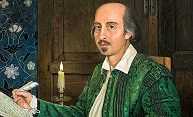
In 2016 English artist Geoffrey Tristram from Stourbridge, West Midlands paints a New Portrait of William Shakespeare for the 400th anniv. of his death, claiming it's the most realistic yet.
In 2016 the New Oxford Ed. of Shakespeare gives Christopher Marlowe credit for co-writing the Henry VI trilogy with William Shakeseare.
On June 12, 2017 Delta Air Lines announces that it's terminating its 4-y.-o. sponsorship of New York City's Public Theater for producing a version of Shakespeare's "Julius Caesar" in Central Park that portrays Caesar as Donald Trump, showing him being stabbed to death onstage; Bank of America does ditto.

In 2246 notorious Kodos the Executioner, who is posing as a Shakespearean actor is smoked out in Earth Colony Tarsus IV by Capt. Kirk of the Federation Star Ship Enterprise :)